 How-to
Signs of Water Damage in Attic Insulation
Table of Contents
- Signs of Water Damage in Attic Insulation: What Homeowners Miss
- Visible Clues: Stains, Discoloration, and Dripping Water
- Hidden Clues: Odors, Texture Changes, and Sagging
- Signs of a Roof Leak in the Attic vs. Condensation or HVAC Moisture
- How to Find a Hidden Roof Leak: A Step-by-Step Attic Inspection
- Mold in Attic Insulation: Health Risks and Warning Signs
- Water-Damaged Insulation Replacement: Dry vs. Replace Decision Guide
- When to Call a Professional for Attic Water Damage
- Conclusion: Act Early to Protect Your Home
- Frequently Asked Questions
Last Updated: October 13, 2026
Signs of Water Damage in Attic Insulation: What Homeowners Miss
Water damage in attic insulation turns a small roof leak into a five-figure repair. This guide covers the signs of water damage in attic insulation, how to tell a roof leak from condensation, and when to dry versus replace.
Most homeowners catch the problem too late. By the time a brown ring shows up on the ceiling, moisture has been sitting in the insulation for weeks or months, even when it looks fine from the hatch.
Below, we break down the visible and hidden clues, a step-by-step inspection you can do yourself, and the dry-versus-replace decision that trips up almost everyone.
Visible Clues: Stains, Discoloration, and Dripping Water
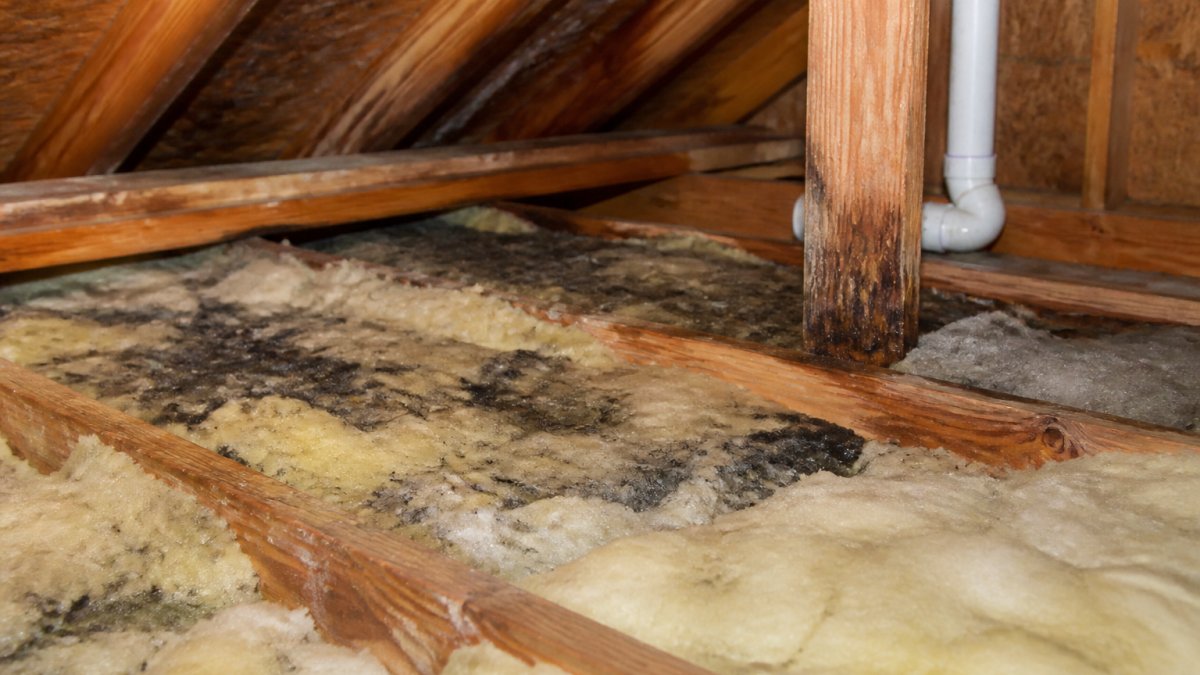
The clearest sign of attic water damage is discoloration on wood, drywall, or insulation. Brown or dark rings on roof sheathing and rafters mark where water has pooled and dried repeatedly.
Other visible clues include:
- Water stains on ceilings and walls below the attic
- Dark streaks running down rafters or roof sheathing
- Wet or damp insulation that feels heavy and clumped
- Dripping water or active leaks during or after rain
- Peeling paint or bubbling drywall near the ceiling line
- Sagging ceiling sections that feel soft to the touch
Roof sheathing, the plywood layer under your shingles, warps, delaminates, and loses strength when it stays wet.
The U.S. Department of Energy guide to home moisture control notes that uncontrolled moisture in a home can damage the building structure over time.
Hidden Clues: Odors, Texture Changes, and Sagging
The signs you cannot see are often worse. A musty smell in the attic or upper floor usually means mold or mildew is already growing.
Texture tells you a lot. Healthy insulation stays light and fluffy. Wet insulation mats down, clumps, and loses its loft. Once fiberglass or cellulose insulation compresses, it stops insulating well.
Watch for these hidden signals:
- A musty or earthy smell that gets stronger on humid days
- Insulation that looks flat, dark, or compressed
- Soft spots in the ceiling that sag under light pressure
- Rust on nails, screws, or metal vents in the attic
- Peeling paint or bubbling drywall on upper-floor walls
Humidity makes all of this worse. Damp rooms and poor air circulation give moisture nowhere to go.
Signs of a Roof Leak in the Attic vs. Condensation or HVAC Moisture
A roof leak and condensation look similar but need very different fixes.
Start with timing. If the stain, drip, or damp insulation shows up during or right after rain, a roof leak is the leading suspect.
Next, look at where the moisture sits. A roof leak enters at one point and travels, so the stain is often downhill from the hole.
Use this source-by-source checklist to narrow it down:
| Source | Where you see it | When it shows up | Telltale clue |
|---|---|---|---|
| Roof leak at flashing | Near chimneys, skylights, valleys, or vent boots | During or after rain | Concentrated stain that spreads from one point; rust streaks below |
| Roof leak at shingles or underlayment | Along roof lines or deck seams | During or after rain | Dark streaks running down rafters or sheathing |
| Condensation on sheathing | Underside of roof deck, especially north-facing slopes | Cold weather or high indoor humidity | Frost, water beads, or fuzzy dampness across a wide area |
| Condensation on cold pipes or vents | Around plumbing stacks, exhaust vents, or metal penetrations | Cold weather | Drips directly below the cold surface, not under the roof line |
| HVAC duct sweat or leak | Along duct runs, at joints, or near the air handler | When the system runs | Damp insulation directly under or around ducts; musty smell near the unit |
| Furnace or water-heater flue | Near the flue pipe where it passes through the attic | When the appliance runs | Warm, moist air leaking into a cold attic; dampness concentrated at the flue |
| Bathroom or kitchen exhaust | Along the exhaust duct or at its termination | When fans run | Damp insulation along the duct path; condensation at the roof termination |
A leaking roof usually leaves a trail, so the stain may not sit under the actual hole.
Condensation forms when warm, moist air meets a cold surface. Poor ventilation and a furnace flue leaking warm air into the attic both drive this, and sweating or leaking HVAC ducts add moisture too.
If damage appears only in winter, suspect condensation; if it tracks with storms, suspect a roof leak; if it appears only when the HVAC runs, suspect a duct or air-handler issue.
How to Find a Hidden Roof Leak: A Step-by-Step Attic Inspection
Finding a hidden roof leak takes patience and the right sequence. Follow these steps in order.
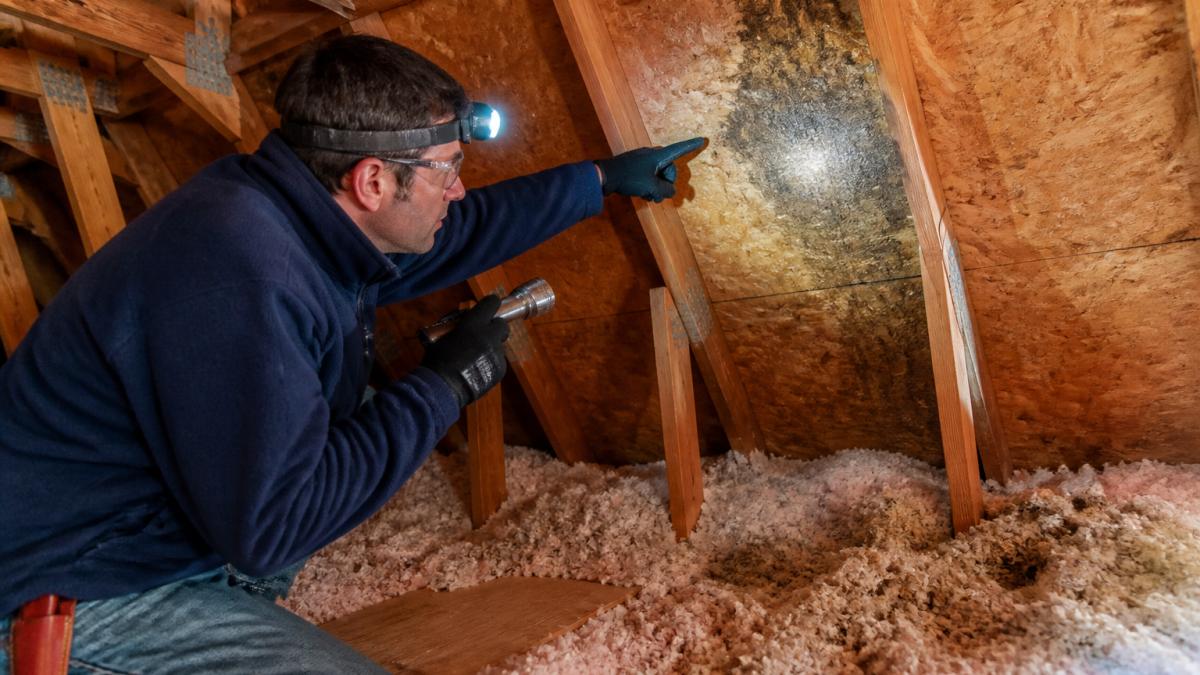
- Pick the right day. Inspect during or right after heavy rain for the best chance of catching an active leak.
- Suit up. Wear a mask, gloves, long sleeves, and safety glasses. Bring a bright flashlight.
- Start at the highest point. Scan roof sheathing, rafters, and the underside of the roof deck first.
- Follow the water. Trace stains upward. Water runs downhill, so the source sits above the stain.
- Check the usual suspects. Look around roof vents, chimneys, skylights, and flashing.
- Test the insulation by touch. Press gently. Damp insulation feels cool and heavy.
- Mark what you find. Use tape or chalk to flag wet spots so you can track them later.
- Measure moisture. A moisture meter gives you a number instead of a guess.
Safe Inspection Precautions Before You Climb Up
Safety comes first. Attics are hot, cramped, and full of hazards.
- Never inspect alone. Have someone nearby.
- Use a sturdy ladder and a stable walkway.
- Wear a respirator if you suspect mold.
- Avoid touching exposed wiring.
- Keep your phone on you for light and emergencies.
Mold in Attic Insulation: Health Risks and Warning Signs
Mold in attic insulation is a health risk, not a cosmetic problem. It needs moisture, and wet insulation is a perfect host.
Warning signs of mold growth include:
- A strong, musty odor that will not go away
- Dark or greenish patches on insulation or wood
- Visible fuzz or speckling on sheathing
- Allergy-like symptoms that ease when you leave the house
Mold and mildew spread fast once they start. The U.S. Environmental Protection Agency's mold guidance recommends fixing the water source first, because mold returns if moisture stays.
Wet insulation damp for more than a day or two is hard to save; replacement is usually safer.
Water-Damaged Insulation Replacement: Dry vs. Replace Decision Guide
Water-damaged insulation replacement is often the only safe option, but not always. The right call depends on the material, how long it has been wet, and whether the source is fixed.
Different materials respond to water differently, so the decision is not one-size-fits-all.
Fiberglass batts and blown fiberglass. Fiberglass itself does not absorb much water, but the binder and the air pockets that give it loft do not survive saturation.
Cellulose. Cellulose is treated with fire retardants and can absorb and hold water. Once it is wet, it clumps, packs down, and loses loft.
Spray foam. Closed-cell spray foam is largely water-resistant and rarely needs replacement unless the foam itself is damaged or the substrate behind it is wet.
Use these criteria to decide:
| Situation | Action | Why |
|---|---|---|
| Fiberglass lightly damp, caught within 24-48 hours | Dry it out | Fast action can save the material |
| Fiberglass soaked, clumped, or compressed | Replace | Loft is gone, insulation value is lost |
| Cellulose wet more than 24-48 hours | Replace | It holds water and is hard to dry thoroughly |
| Spray foam with wet substrate behind it | Remove and replace affected area | Trapped moisture can feed mold |
| Any mold growth present | Replace | Mold cannot be cleaned from insulation |
| Wet more than 48 hours | Replace | Mold risk is too high |
| Contaminated by dirty water | Replace | Health risk remains after drying |
Drying works only when you catch the moisture fast, fix the source, and provide strong air circulation.
Verification matters. Use a moisture meter at several spots and write the readings down; if the numbers stay high, the insulation has to go.
When to Call a Professional for Attic Water Damage
Call a professional when the source is not obvious, mold is present, or the damage spans a large area.
Reach out if you notice:
- Structural damage to rafters or sheathing
- Widespread mold growth
- A leak you cannot trace
- Sagging ceilings or soft drywall
- Damage that keeps returning after repairs
A pro can find the water source, handle safe removal, and fix the roof issue causing it. That last part matters most: replace insulation without fixing the roof and the problem comes right back.
Certified Roofing Solutions Inc. handles residential and commercial roofing repairs and replacements. Our team helps homeowners document damage for insurance claims, and fix the root cause. We also offer preventative maintenance and roof inspections to catch problems early.
Conclusion: Act Early to Protect Your Home
Water in your attic insulation rarely fixes itself. It spreads, feeds mold, and weakens the structure above your head. The longer it sits, the more it costs.
If you spot any of these signs, act now. Certified Roofing Solutions Inc. brings an experienced team, tailored solutions, and a commitment to excellence on every project. We serve homeowners and property managers across the region with top-quality roofing services.
Book an appointment today and let us find the leak before it finds your ceiling.
Frequently Asked Questions
Can you have a roof leak and not know it?
Yes. Slow roof leaks often go unnoticed for months because water travels along rafters and sheathing before showing up as a ceiling stain. In attic insulation, the first clues are usually damp patches, a musty smell, or compressed batting that no longer springs back. By the time you see bubbling drywall or peeling paint, the moisture has likely been present for weeks. Periodic attic inspections, especially after heavy storms, catch these signs early and prevent structural damage.
Does water damage insulation?
Yes. When insulation gets wet, its thermal performance drops sharply. Fiberglass batts lose loft and trap moisture against framing, while cellulose can clump and sag. Wet insulation also creates conditions for mold growth and mildew. The material may not recover even after drying, depending on how long it stayed wet and what type it is. If you find wet insulation, address the water source first, then decide whether drying or replacement is the right next step.
Should wet attic insulation be replaced or dried?
It depends on the material and how wet it got. Fiberglass batts that were briefly damp from humidity may dry out with improved ventilation. But insulation that was soaked by a roof leak, shows mold growth, or has been wet for more than 48 hours usually needs replacement. Cellulose and other porous materials are harder to dry completely and often harbor mold. A moisture meter reading above 20% on framing or insulation is a strong signal to replace.
How do I find a water leak that is not visible?
Start in the attic on a dry day and look for water stains on roof sheathing, darkened rafters, or rusted nail heads. Check insulation for damp spots by pressing gently with a gloved hand. Use a flashlight to trace any discoloration upward toward the roof deck. If you cannot find the source, a professional can use moisture meters and infrared imaging to pinpoint hidden leaks. Document everything with photos for insurance purposes before any repair work begins.