 How-to
Comparing Roofing Contractor Quotes: A Homeowner's Guide
Last Updated: November 5, 2026
Quick Summary
To compare multiple roofing contractor quotes, get at least three bids and normalize them to the same scope, materials, and terms using a line-item worksheet. Compare order quantity in squares, waste factor, exclusions, and warranty terms, and treat price as a tiebreaker rather than the decision.
- Get at least three bids; five or six usually means drowning in paperwork.
- A complete estimate lists materials, labor, tear-off, permits, cleanup, and warranty as separate line items.
- One roof square equals 100 square feet of roofing.
- Waste factor is commonly 10% to 15% for a straightforward gable roof.
- Keep price weighted low on a scorecard so it stays a tiebreaker.
Table of Contents
- Why Roofing Contractor Quotes Differ So Much
- How Many Roofing Quotes Should I Get?
- What a Complete Roofing Estimate Should Include
- Using a Roof Estimate Template to Compare Bids Line by Line
- How to Evaluate Roofing Contractors Before You Sign
- Verifying Roof Measurements, Quantities, and Waste Factor
- Red Flags in Contracts, Deposits, and Change Orders
- Request a Line-Item Quote from Certified Roofing Solutions Inc.
- Frequently Asked Questions
Why Roofing Contractor Quotes Differ So Much
Two bids for the same roof can land thousands of dollars apart, and neither contractor is necessarily wrong. Comparing multiple roofing contractor quotes means looking past the bottom-line number and reading what sits behind it. This guide walks through the line items that drive price gaps, so you can tell a genuinely better bid from a cheaper one.
A roofing estimate is a written breakdown of the materials, labor, and terms for a specific roof project. A roofing quote usually locks in a firmer figure for that same scope.
Most guides tell you to pick the middle bid.
The usual suspects behind a price difference:
- Scope of work. One bid includes tear-off and decking repair; another assumes a roof-over.
- Materials specification. Product grade, shingle line, and underlayment type vary widely.
- Labor and installation method. Crew size, timeline, and detail work change the number.
Below, we show you how to normalize every bid to the same scope, spot the gaps, and choose with confidence.
How Many Roofing Quotes Should I Get?
Get at least three roofing contractor quotes. Three bids give you a real price range and expose outliers. One bid tells you nothing, and two can leave you guessing which one is honest.
Collecting five or six quotes usually means drowning in paperwork. Three to four well-documented bids are enough to see the pattern.
Ask each contractor for the same things so the bids line up:
- The same scope: full replacement versus repair
- The same material grade and manufacturer
- A line-item breakdown, not a lump sum
What a Complete Roofing Estimate Should Include
A complete roofing estimate lists materials, labor, tear-off, permits, cleanup, and warranty terms as separate line items. If a bid arrives as one total with no breakdown, you cannot compare it to anything. Ask for the itemized version before you judge the price.
A complete estimate generally spells out:
- Roof measurements and squares, plus the waste factor
- Materials specification: shingles, underlayment, ice and water barrier, flashing, drip edge, ridge vent
- Decking repairs and how hidden damage gets priced
To see the full scope of residential work a complete bid should cover, review our roofing services.
Using a Roof Estimate Template to Compare Bids Line by Line
A roof estimate template turns a stack of confusing bids into one apples-to-apples comparison. Build a simple grid with each contractor as a column and every scope item as a row.
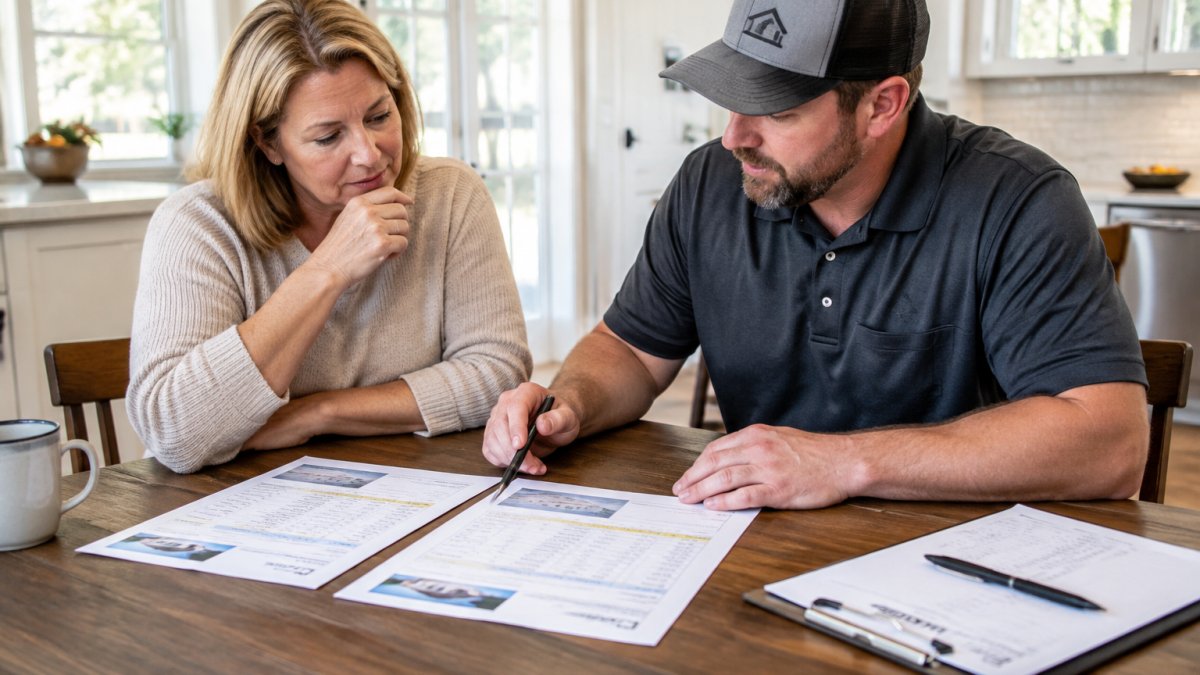
Here is the comparison worksheet we suggest. Copy it into a spreadsheet and fill in one column per bid:
| Line Item | Bid A | Bid B | Bid C | Notes |
|---|---|---|---|---|
| Roof squares + waste factor | Match quantities first | |||
| Shingle brand and product grade | Same tier or flag it | |||
| Underlayment type | Synthetic vs. felt | |||
| Ice and water barrier | Included or extra? | |||
| Flashing and drip edge | New or reused | |||
| Ridge vent and ventilation | Count the vents | |||
| Decking repair allowance | Per-sheet price? | |||
| Tear-off and dumpster | Included? | |||
| Permits | Who pulls it? | |||
| Cleanup and debris removal | Magnet sweep? | |||
| Workmanship warranty (years) | Get it in writing | |||
| Payment schedule and deposit | Deposit size | |||
| Total project cost | Compare last, not first |
Fill every cell. A blank cell is a question for that contractor, not a zero.
Normalize the bids before you score them
A worksheet only works if every column describes the same job. If Bid A includes tear-off and Bid B assumes a roof-over, add the missing tear-off line to Bid B using that contractor's own per-square or per-layer price.
A common pattern is that the lowest bid becomes the highest once you add the exclusions back in. Normalizing exposes that before you sign anything.
Score each bid with a weighted decision framework
Price should be one column, not the decision. A simple weighted scorecard keeps you from defaulting to the lowest number. Assign points on a 1-5 scale for each category, then multiply by the weight that reflects what matters most on your project.
| Category | What you are scoring | Suggested weight |
|---|---|---|
| Scope completeness | Every required line item is included and priced | 25% |
| Credentials and insurance | License, liability, workers' comp verified | 20% |
| Materials and specifications | Product tier, underlayment, flashing, ventilation | 15% |
| Warranty terms | Workmanship years and manufacturer coverage in writing | 15% |
| Communication and responsiveness | Clear answers, itemized bid, references reachable | 15% |
| Price | Normalized total after scope adjustments | 10% |
Multiply each 1-5 score by its weight, then add the results. A bid that scores 4s across scope, credentials, and warranty will usually beat a low-price bid that scores 2 on scope completeness, and the math gives you a defensible reason to explain your choice to a spouse, a lender, or an insurer.
Watch out: weighting price at 50% or more quietly turns the scorecard back into a lowest-bid contest. Keep price as a tiebreaker unless your budget genuinely cannot absorb the difference.
Turn the worksheet into questions for each contractor
Every blank cell and mismatch is a script for your next call. Ask Bid B to price the tear-off it excluded, ask Bid C to confirm whether the ice and water barrier is included, and ask all three to state the workmanship warranty in years and put the change-order process in writing. The worksheet is a list of clarifications that forces every bid onto the same footing before you commit.
How to Evaluate Roofing Contractors Before You Sign
Evaluate roofing contractors on credentials first, price second. Check the license, liability insurance, workers' compensation coverage, and local references before you weigh a single number. A cheap bid from an uninsured crew is the most expensive bid on the table.
A few checks that separate pros from pretenders:
- Confirm the license and insurance certificates directly, not just verbally.
- Ask for references from jobs similar to yours, and call them.
- Check that the contractor pulls permits and knows local building codes.
For a deeper set of vetting criteria, read our guide on finding a reputable roofing contractor. It covers the reputation and credential checks that matter before you commit.
Verifying Roof Measurements, Quantities, and Waste Factor
Verify the roof measurements and quantities before you trust any total. Roof area is measured in roof squares, where one square equals 100 square feet of roofing. Pitch, hips, valleys, and penetrations all add material, so the square count and waste factor should appear in the bid.
If one bid lists 28 squares and another lists 34 for the same house, someone measured wrong or padded the job. Ask each contractor to show the measurement report.
Check the measurement report, not just the square count
Most contractors generate measurements from an aerial measurement service or a manual walk. Either is fine, but the report should show total roof area in squares, predominant pitch, number of layers to be removed, ridge and hip length, valley length, eave and rake length, and the number of penetrations such as vents, skylights, and chimneys.
Pitch matters because steeper roofs require more material, labor, and safety setup, a 4/12 and an 8/12 roof of the same footprint do not cost the same to replace. Layer count matters because a second layer means additional tear-off labor and disposal.
Understand how waste factor changes the quantity
The waste factor covers cutoffs, overlaps, valleys, and damaged material. A reasonable allowance protects you from change orders mid-job. Too low, and you pay extra later.
Waste is usually a percentage added to the base square count, commonly 10% to 15% for a straightforward gable roof, with more for complex roofs with many valleys, hips, and penetrations.
Watch out: a bid that shows a suspiciously low waste factor may be planning to charge you for shortfalls as a change order once the crew starts cutting.
Normalize quantities across bids
To compare fairly, convert each bid to order quantity in squares, then check that the material line, underlayment line, and dumpster size all scale with that number. A bid with 33 squares of shingles but underlayment for 28 squares has a gap you should question, as does a dumpster sized for one layer when the report shows two.
Materials like underlayment and ice and water barrier are easy to overlook. To understand what these components do and why their inclusion changes a bid, see our explainer on roof underlayment.
Ask for the per-square price
Once quantities are normalized, ask each contractor for the per-square price of the installed system. It strips out the quantity difference and shows the actual rate, and a contractor who will not state one is telling you something about how the bid was built. Use that number alongside the worksheet to confirm the total makes sense for the scope.
Red Flags in Contracts, Deposits, and Change Orders
Watch for large upfront deposits, vague change-order language, and contracts with no written scope. A written contract should match the bid line for line, including exclusions and allowances.
Specific red flags to catch before signing:
- Big deposits. A deposit far above material costs leaves you exposed if the crew walks.
- No change-order process. Hidden damage should have a written per-item price, not a verbal "we'll figure it out."
- Missing exclusions. If the bid does not say what is excluded, assume it is extra.
Hidden damage is the classic surprise. Ask each contractor how they price additional costs if they open the roof and find rotten decking. Our list of common roofing mistakes shows the traps to avoid.
Request a Line-Item Quote from Certified Roofing Solutions Inc.
The best bid is the one you can read line by line and compare without guesswork. Once your worksheet is ready, request a line-item quote and hold every contractor to the same scope, materials, and terms.
Certified Roofing Solutions Inc. provides residential and commercial roofing services in Marietta, Alpharetta, Dunwoody, and Johns Creek, GA. Ready to compare on equal footing? Contact us to request your itemized quote.
Frequently Asked Questions
What is the 25% rule for roofing?
The 25% rule is a rough guideline some roofers use to decide whether a roof can be repaired or needs full replacement. If roughly a quarter or more of the roof surface is damaged, patching usually stops making financial sense. Treat it as a conversation starter, not a rule. Ask each contractor to show you the damaged sections and explain why repair or replacement is the better call for your specific roof.
How many roofing contractor quotes should I get?
Three written quotes is the standard recommendation. Two makes it hard to spot an outlier, and four or more rarely changes the decision once you have a clear scope of work. What matters more than the number is that every bid covers the same materials, installation method, and exclusions. A third quote is most useful when the first two differ widely in price or scope.
Should I choose the cheapest roofing quote?
Rarely. A low bid often reflects a thinner scope: fewer layers of underlayment, no ice and water barrier, standard shingles instead of architectural grade, or missing permits. Compare line items, not totals. If one quote is significantly lower, ask the contractor to explain exactly what is excluded. The right choice is the bid that covers the full scope at a fair price with solid warranties.
How long should a roof replacement estimate be valid?
Most roofing estimates hold for 30 days, though material prices and crew schedules can shift that window. Ask each contractor how long their quote is valid and whether the price is locked. If you are waiting on an insurance claim, tell the contractor upfront so they can account for the timeline. Get any extension in writing before the original estimate expires.
Comparing roofing contractor quotes is not about finding the cheapest number. It is about finding the bid that matches your scope, explains every line, and comes from a crew you can trust. Certified Roofing Solutions Inc. gives you itemized estimates, insurance claim support, and clear warranty terms so the decision is simple. Get started with Certified Roofing Solutions Inc. and compare your next roof quote with confidence.