 How-to
Common Causes of Metal Roof Water Infiltration
Table of Contents
- Why Metal Roofs Leak: The 8 Causes That Account for Most Water Infiltration
- Metal Roof Fastener Problems: Loose, Missing, and Overdriven Screws
- Metal Roof Flashing Leaks Around Chimneys, Vents, and Skylights
- Panel Seams, Overlaps, and Standing Seam Failures
- How to Find a Leak in a Metal Roof: A Safe Step-by-Step Workflow
- Metal Roof Condensation: The Leak That Isn't a Leak
- Rust, Corrosion, and Damaged Panels From Weather Exposure
- Diagnosis and Repair: Matching the Fix to the Cause
- Frequently Asked Questions
Last Updated: October 19, 2026
Why Metal Roofs Leak: The 8 Causes That Account for Most Water Infiltration
Metal roofs last decades but are not immune to leaks. The common causes of metal roof water infiltration come down to a short list: failed fasteners, bad flashing, seam problems, poor installation, corrosion, and weather.
A metal roof rarely fails because the panels wore out. It fails at the edges, holes, and joints.
Below, we break down the eight causes that explain most leaks, then show how to trace one to its source and match the repair.
Metal Roof Fastener Problems: Loose, Missing, and Overdriven Screws
Fastener problems are the number one cause of metal roof leaks. Each panel screw carries a small rubber washer under its head.
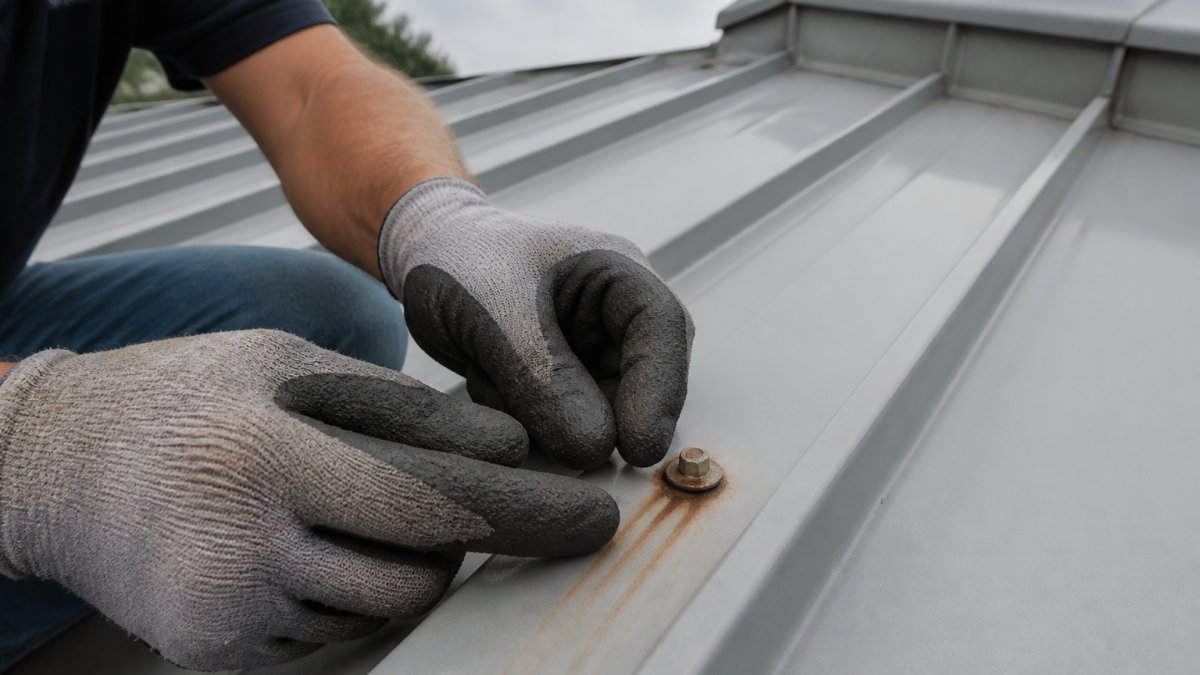
Three failures do most of the damage:
- Loose screws back out from thermal expansion and contraction, leaving a gap around the hole.
- Missing fasteners leave an open hole with no seal at all.
- Overdriven screws crush the washer flat or dimple the panel, so the seal fails and water pools in the dent.
Underdriven screws are just as bad. The washer never seats, so wind-driven rain slips underneath.
Cranking down on a loose screw usually overdrives it and makes the leak worse. The fix is a fresh screw with a new washer, set flush with the panel.
Metal Roof Flashing Leaks Around Chimneys, Vents, and Skylights
Metal roof flashing leaks happen wherever the roof meets something else. Flashing seals the edges around chimneys, vents, pipes, and skylights, and it is the most vulnerable part of any roof because it depends on sealant and a tight fit.
Flashing fails in a few predictable ways:
- The sealant under the flashing dries and pulls away.
- Nails or screws work loose over time.
- The flashing was cut short or bent wrong during installation.
Chimneys and skylights are the worst offenders: they are big, sit in the path of running water, and collect debris.
Panel Seams, Overlaps, and Standing Seam Failures
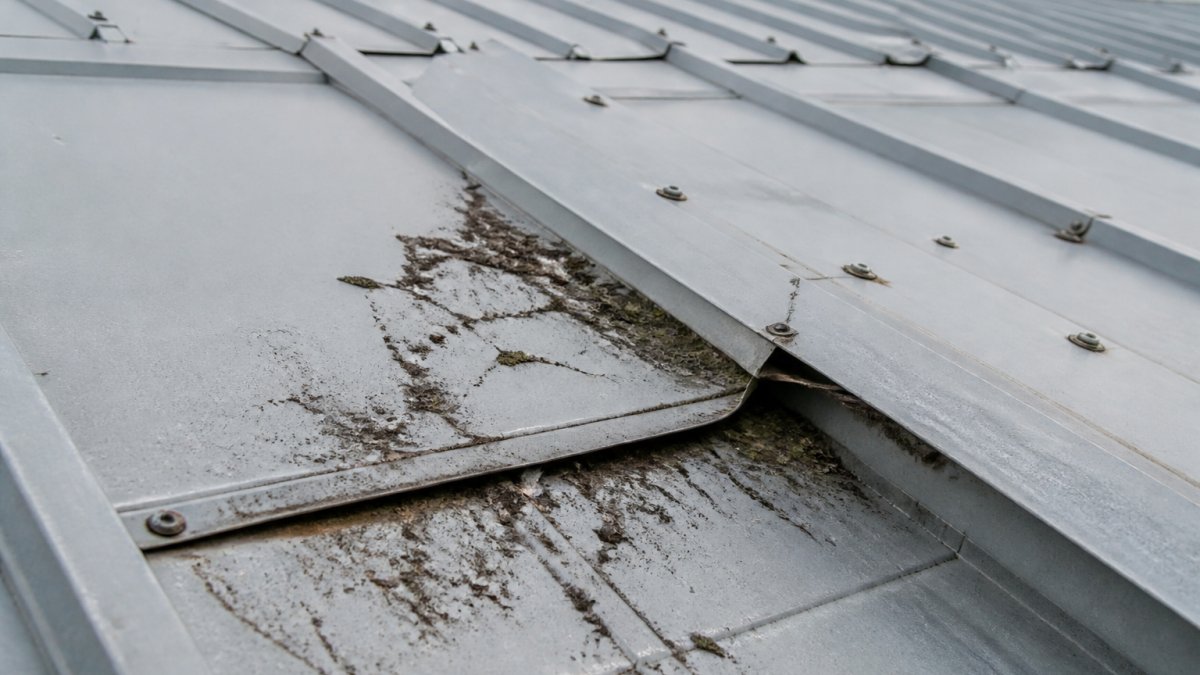
Panel seams and overlaps are where water gets its easiest path in. On exposed-fastener panels, each panel overlaps the next, and that overlap relies on a sealant strip or butyl tape.
Standing seam roofs handle water better because the seams are raised and hidden fasteners hold the panels down. But standing seam still fails at the seams when:
- The seams were not crimped or folded correctly.
- Thermal movement works the seam loose over years.
- The sealant inside the seam breaks down.
A common mistake is assuming a standing seam roof cannot leak at the seams. It can, and because those failures are harder to spot, they often go undiagnosed until the ceiling stains.
How to Find a Leak in a Metal Roof: A Safe Step-by-Step Workflow
Finding a metal roof leak starts inside, not on the roof. Water travels along framing, purlins, and underlayment before it drips, so the ceiling stain is rarely directly under the entry point. Trace it back before you climb.
Our rule: diagnose from the attic first, test from the roof only when conditions are dry and safe.
Step 1: Map the stain from inside
Go into the attic during or right after a rain with a bright light. Look for:
- Wet or darkened sheathing and rafters
- Rust streaks or water trails on fastener shanks that protrude through the deck
- Drip marks on the top plate of walls, which often point to a leak higher up the slope
Mark the highest wet point you find. Water almost always enters above where it exits, so the true source sits uphill.
Step 2: Classify the symptom before you test
Different causes leave different signatures. Use this comparison to narrow the suspect list before getting on the roof.
| Symptom | Most likely cause | What confirms it |
|---|---|---|
| Wet underside across a broad area, worst on cold mornings | Condensation | No rain needed; dries as the day warms |
| Drip directly below a fastener line | Fastener or washer failure | Rust ring or crushed washer at the screw head |
| Water at a chimney, vent, or skylight | Flashing failure | Gap, lifted edge, or dried sealant at the flashing base |
| Water along a panel overlap or raised seam | Seam or overlap failure | Loose overlap, dried butyl tape, or open standing seam |
| Water at the eave or inside the wall after heavy rain | Drainage or ice-dam backup | Clogged gutter, backed-up downspout, or ice at the eave |
| Water only during wind-driven rain | Wind-driven infiltration at seams or penetrations | Leak appears in storms but not in calm rain |
If the symptom points to condensation, stop here. Patching the roof will not fix a ventilation problem, and you will chase the same drip for years.
Step 3: Inspect the roof safely, in dry conditions
Never walk a wet metal roof; it is slick and unforgiving in a fall. Inspect from a ladder at the eave, a drone, or the ground with binoculars first. If you must go up, do it on a dry day, wear soft-soled shoes, and stay off steep pitches and wet seams.
On the roof, check in this order, because it matches how water actually enters:
- Penetrations and flashing, chimney, vents, pipes, skylights, and any place the roof meets a wall.
- Fastener lines, look for backed-out screws, missing screws, crushed washers, and rust rings.
- Seams and overlaps, lift the edge of an overlap gently; if the butyl tape is dry or the seam is open, that is a suspect.
- Panel edges and ridge, check end laps, ridge caps, and eave trim for gaps and loose fasteners.
- Drainage path, gutters, downspouts, and valleys, especially after debris has collected.
Step 4: Test with controlled water, low and slow
A hose test turns a guess into a diagnosis, but only if run correctly.
- Have a helper inside with a phone or radio.
- Start at the lowest suspect point and work uphill, one area at a time.
- Run water low and slow for several minutes at each spot. A hard spray splashes everywhere and tells you nothing.
Step 5: Decide who should make the repair
Careful homeowners can reasonably replace a missing screw with a new fastener and washer, clear a clogged gutter, or re-seal a small, accessible flashing gap. Reworking chimney or skylight flashing, re-crimping standing seams, replacing rusted-through panels, and any repair on a steep or wet roof should go to a roofer.
If the leak returns after one repair, stop patching. A repeat leak usually means the diagnosis was wrong, not that the patch was weak.
Metal Roof Condensation: The Leak That Isn't a Leak
Metal roof condensation is often mistaken for a leak. When warm, moist air from inside meets a cold roof panel, water forms on the underside and drips, looking exactly like a leak.
Condensation shows up on cold mornings, after temperature swings, or in humid weather; rain leaks show up during or right after a storm.
The fix differs too: condensation is a ventilation and insulation problem, not a roofing hole.
Rust, Corrosion, and Damaged Panels From Weather Exposure
Corrosion eats metal roofs from the fasteners and cut edges inward. Rust starts small at a scratched panel, cut edge, or fastener head, then spreads under the coating. Once it reaches the base metal, the roof can no longer shed water reliably and patching is temporary.
How corrosion actually starts
Metal roof panels rely on a protective coating, typically a metallic or paint finish over steel or aluminum. That coating fails in predictable places:
- Cut edges, field-cut panels expose bare base metal at every end and side lap.
- Fastener heads, a scratched or under-coated screw head becomes a rust seed that stains the panel below it.
- Scratches and abrasion, foot traffic, ladders, and fallen limbs break the coating.
Why failure points differ by roof system
Not every metal roof fails the same way, and the repair path changes with the system.
| Roof system | Primary leak points | What to watch |
|---|---|---|
| Exposed-fastener panels | Fastener washers, panel overlaps, end laps | Backed-out screws, dried butyl tape, rust rings at fasteners |
| Standing seam | Seams, clips, flashing terminations | Unfolded or uncrimped seams, sealant breakdown inside the seam, thermal movement |
| Through-fastened vertical panels | Side laps, ridge and eave trim | Loose overlaps, missing closure strips |
| Architectural metal with concealed clips | Clip and seam interfaces, penetrations | Hidden movement, hard-to-spot seam leaks |
Panel profile matters: a low-profile panel with wide flats sheds water more slowly than a high-rib profile, so it is less forgiving of a failed washer or loose overlap.
Roof age changes the diagnosis. On a newer roof, a leak usually points to an installation defect like an overdriven screw or short flashing; on an older roof, the same symptom more often means worn washers, dried seam tape, or coating failure.
Weather exposure and the damage it leaves
Weather speeds corrosion and opens new entry points:
- Heavy snow and melt sit on the roof for days and keep seams and fasteners wet.
- Ice dams at the eaves push water up under panels and into the attic.
- Clogged gutters and downspouts back water up along the eave and behind trim.
Repair durability and material compatibility
A repair is only as good as its materials. Three rules:
- Match the metal. Use fasteners, flashing, and sealants compatible with the panel's base metal. Mixing metals, such as a copper flashing against a steel panel, sets up galvanic corrosion at the joint.
- Match the sealant to the joint. Butyl tape is the standard for panel laps and seams. Polyurethane sealants work for many flashing details. Silicone is common at dissimilar-material joints but has limited adhesion to some painted finishes. A sealant that is not compatible with the panel coating can peel and take the coating with it.
- Avoid temporary patches that trap moisture. A smear of caulk over a rusted fastener hides the problem for a season and can trap water against the panel, accelerating corrosion underneath.
For rusted panels, options are limited. Small rust spots can be treated and recoated, but once rust has perforated the panel, replacing the affected section is the reliable fix. Coatings and sealants slow corrosion; they do not reverse it.
Diagnosis and Repair: Matching the Fix to the Cause
The right repair depends entirely on the cause. This is where most leaks come back.
Use this decision path to match the fix to the problem:
| Cause | How to Confirm It | Correct Fix |
|---|---|---|
| Loose or missing screws | Backed-out or absent fasteners with open holes | Replace with new screws and washers |
| Overdriven screws | Crushed washers, dimpled panels | New fasteners set flush, not over-tightened |
| Flashing failure | Gaps, dried sealant, loose flashing at chimney or vent | Rework or replace the flashing |
| Seam or overlap failure | Loose overlap, dried tape, open seam | Re-seal with butyl tape or re-crimp the seam |
| Condensation | Wet underside on cold mornings, no rain needed | Fix ventilation and insulation |
| Rust and corrosion | Spreading rust at edges or fastener heads | Treat or replace the affected panels |
Two things matter for a lasting repair: match the material (use fasteners and sealants compatible with the panel's metal, since mixing metals causes corrosion) and fix the cause, not the symptom.
If you are unsure which cause you are looking at, or the leak keeps coming back, get a professional roof inspection.
Frequently Asked Questions
What is the most common cause of metal roof leaks?
Fastener problems top the list. Screws back out as the panels expand and contract with temperature swings, and the rubber washer under each head dries out and cracks over time. Once that seal breaks, water works in around the shank. Failed flashing and deteriorated sealant at seams rank close behind. A metal roof leaks most often at its weakest connection points, not through the panels themselves, which is why a focused inspection of fasteners and flashings usually finds the source quickly.
How can you find the source of a leak on a metal roof?
Start inside the attic during daylight or with a bright light, looking for water stains, dark streaks, and daylight at panel joints. Trace the stain upward, since water travels along the panel before it drips. On the roof, check fasteners for backing out, washers for cracking, and flashing for lifted edges. A second person with a garden hose can wet one section at a time while the first watches below. Never walk a wet metal roof; call a professional if the slope is steep or the panel surface is slick.
Can condensation be mistaken for a metal roof leak?
Yes, and it happens often. Condensation forms when warm, moist attic air meets the cooler underside of the metal panels, and the moisture drips onto insulation and ceiling boards. The tell is timing: condensation shows up on cold mornings or during humid stretches without rain, while a true leak appears during or right after a storm. Rust on the underside of the panels and damp insulation near the ridge point to condensation. Fixing it means improving attic ventilation and sealing air leaks, not repairing the roof surface.
Can loose or missing fasteners cause a metal roof to leak?
They can, and they are one of the easiest problems to catch early. Each fastener holds a rubber washer that compresses against the panel to form a watertight seal. When a screw backs out, the washer no longer sits tight, and wind-driven rain pushes under the head. Overdriven screws crush the washer, while underdriven ones leave a gap. Missing fasteners leave an open hole. A maintenance check that replaces worn screws and washers every few years prevents most of these leaks from starting.