 How-to
Tips for Matching Old Roof Shingles Without Guesswork
Last Updated: November 6, 2026
Quick Summary
Matching old roof shingles starts with building a written profile of what is already on the roof before you buy anything. Record the material, brand and product line, style, dimensions and exposure, granule blend, edge shape, and slope and condition. Then bring that profile to a supplier, since color alone is the most common reason a replacement looks wrong.
- Confirm the roof material first, since asphalt shingles follow different matching rules than wood, slate, tile, or metal.
- Check wrappers, invoices, permit files, or the shingle back for the brand, product line, and stamp text.
- Measure a full shingle and its exposure, because exposure determines whether a replacement sits flush.
- Compare shingles in natural daylight and from street view, since indoor light and close inspection can mislead.
- If a product is discontinued, check leftover stock, salvage sources, and the closest current equivalent before choosing a larger replacement.
Table of Contents
- Why Matching Old Roof Shingles Is Harder Than It Looks
- How to Identify Roof Shingles Before You Buy Replacements
- Safely Removing a Shingle Sample Without Damaging the Roof
- Roof Shingle Color Matching: Light, Weathering, and Viewing Distance
- What to Do When the Original Shingle Line Is Discontinued
- Estimating Roof Shingle Repair Cost and Repair Versus Replacement
- Booking a Shingle Match Assessment With Certified Roofing Solutions Inc.
- Frequently Asked Questions
Why Matching Old Roof Shingles Is Harder Than It Looks
Matching old roof shingles is one of the hardest parts of a roof repair. A patch can look fine on the day it goes on, then stand out for years.
The core problem is time. Asphalt shingles change as they age. Sun, rain, and heat fade the color, and granules wear away. A new shingle sits next to a 15-year-old one and the difference is obvious.
Manufacturers also change their lines. A shingle installed on your roof may no longer be made. Even when it is still sold, the color name may be the same while the blend is different.
Here is what makes matching hard:
- Fading: Sun exposure lightens the surface over time.
- Granule loss: Worn granules change how the shingle reflects light.
- Discontinued products: The exact product may not exist anymore.
- Batch variation: Shingles from different production runs can differ slightly.
The goal is not always a perfect match. A close match that blends well from the street is often the realistic target.
How to Identify Roof Shingles Before You Buy Replacements
Color is the first thing homeowners notice and the last thing that should drive the purchase.
Step 1: Confirm the material. Asphalt shingles are the most common residential roofing material, but confirm your roof's material before buying replacements. Asphalt shingles have a mat core coated with granules.
Step 2: Find the brand and product line. Check the wrapper left in the attic or garage, old invoices, or the permit file.
Step 3: Note the style. Three-tab shingles have a flat, uniform look with a single tab layer.
Step 4: Measure dimensions and exposure. Measure the overall length and width of a full shingle, then measure the exposure, the visible part of each course after the next course overlaps it.
Step 5: Describe the granule blend and edge. Note the base color, any secondary color, and whether the granules are mixed, streaked, or solid.
Step 6: Record the roof slope and condition. Note whether the sample came from a steep or low-slope section, and whether the surrounding shingles are brittle, curling, or losing granules.
Write all of this down and bring it to the supplier. A roofing supplier can usually narrow options faster with dimensions, exposure, and product-line details than with a color description alone.
The article lays out six steps to build a written profile of your shingles before buying replacements.
| Step | What to do | Key detail |
|---|---|---|
| Confirm the material | Identify whether the roof is asphalt, wood, slate, tile, or metal | Asphalt is most common; others follow different rules |
| Find the brand and product line | Check wrappers, invoices, permit files, or the shingle back | Record exact stamp text and code numbers |
| Note the style | Distinguish three-tab from architectural shingles | Style narrows options faster than color |
| Measure dimensions and exposure | Measure a full shingle and its visible exposure | Record actual measurements, not assumed standards |
| Describe granule blend and edge | Note base and secondary color, blend, and edge shape | Same color name can still look mismatched |
| Record slope and condition | Note slope location and whether shingles are brittle | Brittle shingles may force a larger replacement |
Safely Removing a Shingle Sample Without Damaging the Roof
Sometimes a shingle sample gives the best match. Taking one safely matters, both for your roof and for your safety.
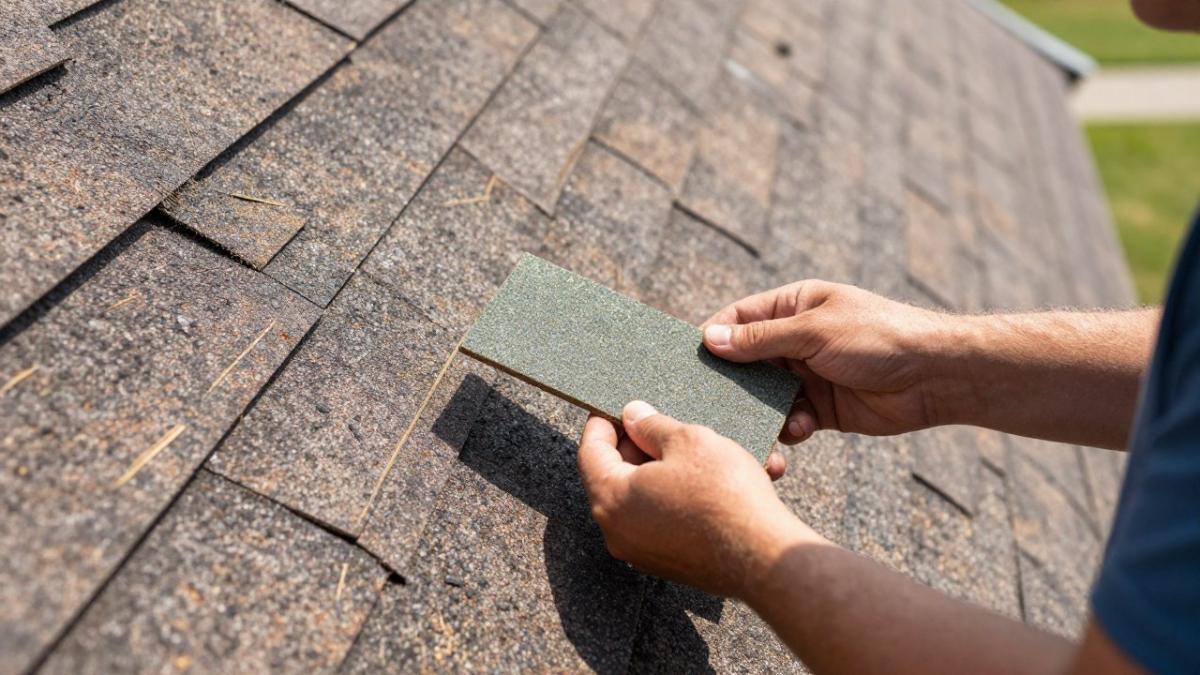
Use these steps:
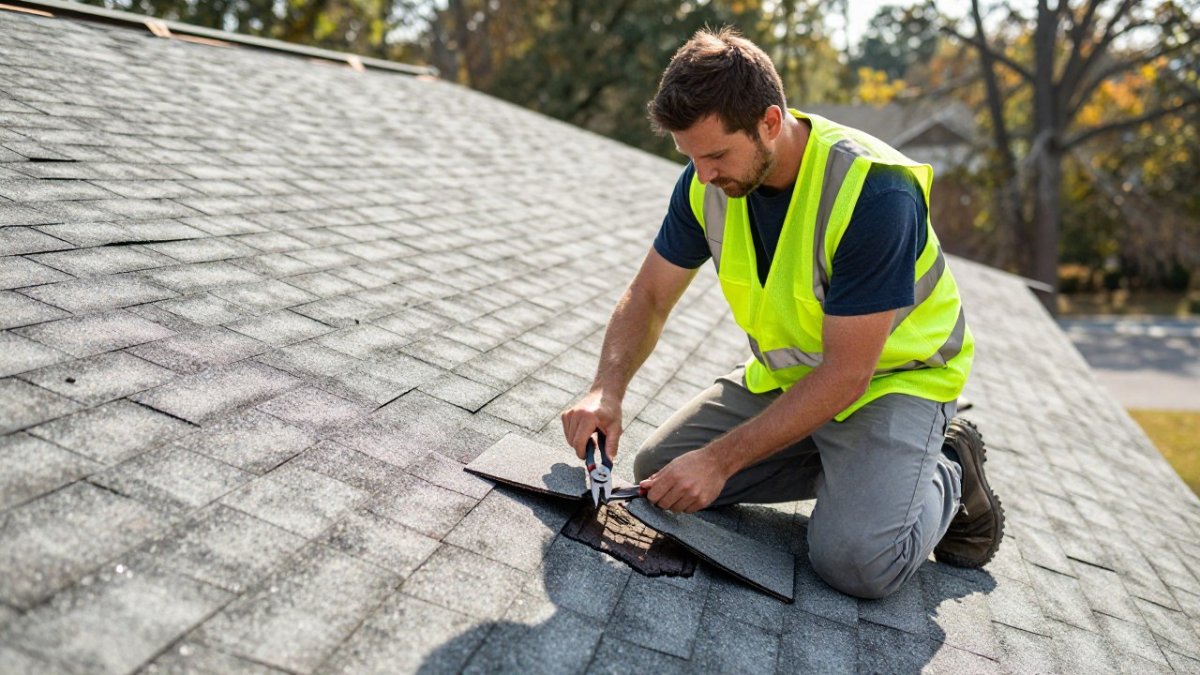
- Pick a hidden spot. Look for a shingle under a ridge, behind a vent, or near the roof edge where it is hard to see from the ground.
- Confirm it is safe to work. Do not climb a wet, steep, or damaged roof. If you are unsure, have a professional take the sample.
- Lift the tabs gently. Use a flat pry tool to lift the shingle above it. Do not force it.
- Remove nails carefully. Slide a thin nail puller under the nail head and pull straight up.
- Pull the sample free. If you plan to handle the repair yourself after sampling, see Repairing Wind Damaged Asphalt Shingles Yourself. Work slowly so you do not crack the surrounding shingles.
- Seal the area. Put roofing cement under the loose tabs once the sample is out.
Be careful on the roof. Falls are a real risk, and a loose shingle can slide. Wear slip-resistant shoes and use fall protection if you have it. If the roof is steep or old, call a licensed roofer instead.
A small fragment often works too. Ask a roofer whether a corner piece from a damaged area will do.
Roof Shingle Color Matching: Light, Weathering, and Viewing Distance
Color matching depends on conditions you do not control. Light, weathering, and distance all change how a shingle looks.
Use natural light. Compare shingles outside during the day. Indoor or evening light can hide differences that show up in sunshine.
Account for weathering. A new shingle will look darker and more saturated than an aged one. Expect the new shingle to lighten over a few seasons. Many people pick a slightly lighter option to plan for that.
Check from the street. Stand where your neighbors would see the roof. A close match from six inches away may look different from 30 feet away. The street view is the one that counts for most homeowners.
Take clear photos. Shoot your roof in full daylight from several angles. Bring the photos to the supplier. Compare them against manufacturer catalog images, keeping in mind that printed colors do not always match real shingles.
Viewing distance matters. A patch on the back slope may be fine even if it is not a perfect match. A patch on the front facade needs a closer match.
What to Do When the Original Shingle Line Is Discontinued
A discontinued product is common on roofs over 15 or 20 years old, and it is not the end of the road.
1. Confirm the product is actually discontinued. Manufacturers retire lines and rename others. Call the manufacturer's customer service line with the product name, the stamp from the back of a shingle, and photos.
2. Hunt for leftover stock. Ask local roofing suppliers and lumberyards whether they have leftover bundles of the old line. Check contractor supply houses, not just retail stores.
3. Check salvage and reclaimed sources. Some suppliers carry reclaimed shingles from tear-offs of matching roofs. Inspect quality before you buy: reclaimed shingles may be brittle, missing granules, or already at the end of their useful life.
4. Ask about the closest current match. Suppliers and roofers often know which current product comes nearest in color, profile, and dimensions. Compare the candidate against your sample in natural light and from the street, not just on a catalog page.
5. Consider a larger partial replacement. If only one slope is damaged, replacing a whole slope or a larger section can make a mismatch far less noticeable than a small patch.
**6.
Appearance is only part of the decision. A near match also has to install correctly and hold up. Before you commit, check these points:
- Dimensions and exposure. The replacement shingle should match the existing exposure so courses line up and the patch sits flush. A shingle that is the right color but the wrong exposure will telegraph through the roof.
- Seal strips and fastening. Confirm the replacement has a compatible seal strip and that nails are placed per the manufacturer's instructions. A shingle that is not sealed down properly can lift in wind.
- Roof slope. Low-slope sections may require a different product or underlayment than steep-slope shingles. Do not assume one shingle works everywhere on the roof.
- Manufacturer instructions. Follow the current manufacturer's installation instructions for the replacement product, even when patching into an older roof.
- Warranty impact. Mixing products can affect warranty coverage. Ask the manufacturer and your roofer how a repair with a different product affects any remaining warranty on the existing roof.
- Code and permit requirements. Local building departments may require permits for roof repairs and may have requirements about matching or repair scope. Check before work starts, especially if you plan to file an insurance claim.
Watch out: a roofer who promises an exact match on a discontinued line without seeing the sample and the roof is guessing. Ask for the candidate product name and compare it yourself before approving the work.
Estimating Roof Shingle Repair Cost and Repair Versus Replacement
Cost depends on the size of the repair, the roof's age, the shingle type, and access. Pricing depends on the size of the repair, the roof's age, the shingle type, and access. For current pricing, contact Certified Roofing Solutions Inc. for a quote. A written quote from a licensed roofer is the only reliable way to know what your job will cost.
Use this framework to decide:
- Repair when damage covers a small area, the roof has useful life left, and a close match is available.
- Replace when the roof is near the end of its life, damage is spread out, or the match is poor across many slopes.
- Compare the numbers. Ask for a repair quote and a replacement quote side by side. Include the cost of future repairs when you compare.
Ask each contractor these questions:
- Is the quote for a match or a best available substitute?
- What happens if the product is discontinued mid-project?
- Does the quote include removal, disposal, and cleanup?
Check with your insurance company before you start. Storm damage may be covered, and claim rules affect how repairs are scoped and paid.
Booking a Shingle Match Assessment With Certified Roofing Solutions Inc.
Matching old shingles takes more than a photo and a guess. Certified Roofing Solutions Inc. provides residential and commercial roofing services in Marietta, Alpharetta, Dunwoody, and Johns Creek, GA.
Visit the Certified Roofing Solutions Inc. website to book an appointment and request a quote for your project.
Frequently Asked Questions
How do you match old roof shingles?
Start by identifying the manufacturer, product line, and approximate age of the existing shingles, using a sample or the shingle wrapper if you have one. Bring a clean fragment to a roofing supplier and compare it under daylight against current catalog options. Check color, granule blend, tab size, and profile, not just the general shade. Because weathering changes color over time, the closest available match is often the realistic goal. Pricing depends on the scope of work, so request a quote from Certified Roofing Solutions Inc. for current figures.
Do roof shingles have to match?
Matching is not always required for the roof to function, but mismatched shingles are noticeable, especially on the front slope and from the street. Visual mismatch can affect curb appeal and, in some cases, resale or insurance discussions. If a full match is not possible, a near match installed carefully in a less visible area or a planned partial replacement can reduce the difference. Discuss the options with a qualified roofer before making a decision.
Can a roofer match shingles that are 20 years old?
Often a roofer can find a close match, but an exact match is less likely for shingles about 20 years old. Manufacturers change product lines, and sun exposure fades granules unevenly over time. A physical sample, photos taken in natural light, and a supplier who can check discontinued lines give the best chance. Expect some color variation and ask for the closest available option rather than a perfect duplicate.
What should you do if replacement shingles do not match the old ones?
First, confirm whether the mismatch is in color, profile, or size, since each needs a different fix. Consider installing the new shingles on a less visible slope, or plan a larger section replacement so the transition looks intentional. Ask your roofer whether a blend of old and new shingles can improve the look. Keep the original product information and photos for future repairs, and talk with your insurer if storm damage is involved.