 how-to
How to Choose a Reputable Roofing Contractor
Table of Contents
- Step 1: Verify Licensing, Insurance, and Local Experience
- Step 2: Gather and Compare Written Estimates
- Step 3: Check Online Reputation, References, and BBB Accreditation
- Key Questions to Ask Roofing Contractors Before You Sign
- Your Roofing Contract Checklist: What Must Be in Writing
- Signs of a Bad Roofing Contractor: Red Flags to Walk Away From
- How to Choose a Reputable Roofing Contractor: Final Steps and Verification
- Frequently Asked Questions
Last Updated: October 3, 2026
Step 1: Verify Licensing, Insurance, and Local Experience
Learning how to choose a reputable roofing contractor starts with paperwork, not promises. A reputable roofing contractor holds a current state license, carries general liability insurance and workers' compensation coverage, and can prove both with documents you can verify before any work begins.
Here's what to check before you sign anything:
- State licensing: Look up the license number in your state's contractor database. Don't accept a photo of a card.
- General liability insurance: Ask for a certificate of insurance and call the insurer to confirm it's active.
- Workers' compensation: If a worker gets hurt on your roof and the crew isn't covered, your homeowner policy may be on the hook.
- Local experience: A contractor who works in your area knows local building codes and permit rules.
Step 2: Gather and Compare Written Estimates
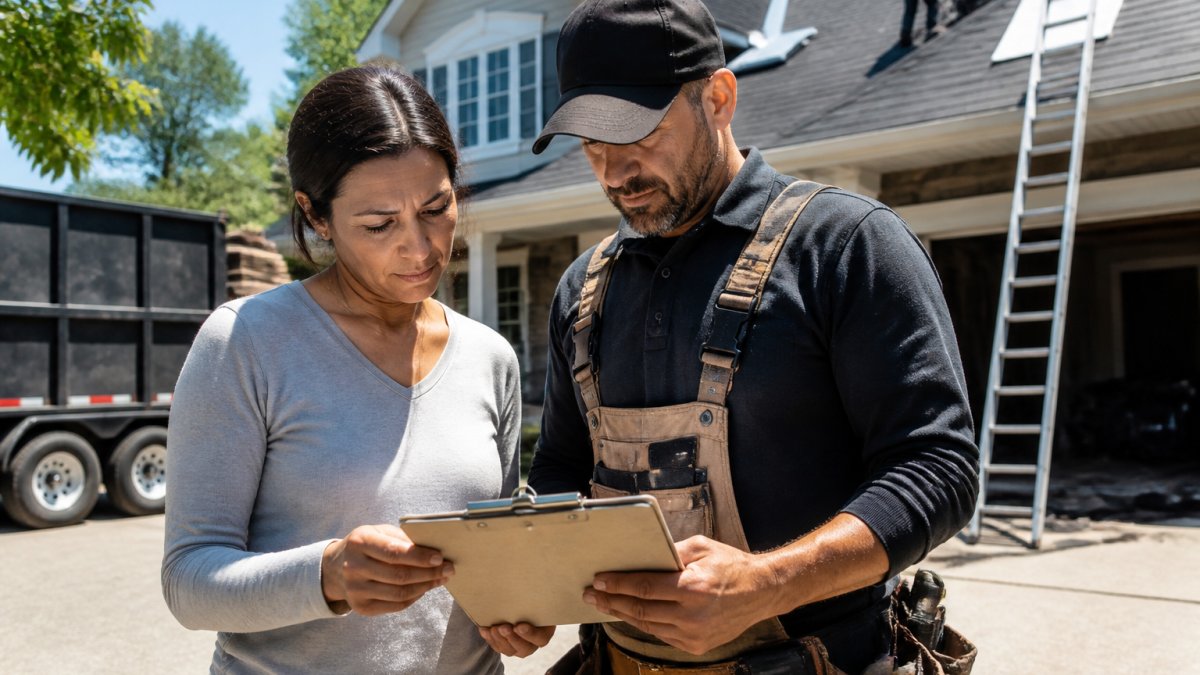
A written estimate is the only estimate that counts. Get at least three, and make sure each one lists materials, labor, project timeline, and cleanup in the same level of detail so you can compare them honestly.
Verbal quotes and "we'll figure it out" pricing are how surprise costs sneak in. The Federal Trade Commission's consumer guidance on home improvement contracts is clear that you should never sign a contract with blank spaces or vague scope language.
When you compare estimates, line them up side by side:
| What to Compare | Why It Matters |
|---|---|
| Materials listed by name | Cheap substitutes change the price and lifespan |
| Tear-off and disposal fees | Often left out, then added later |
| Project timeline | Vague dates mean vague accountability |
| Payment schedule | Never pay in full upfront |
| Workmanship guarantee | Tells you who fixes problems later |
A common mistake is picking the lowest number without reading what's missing. A low bid often means thinner underlayment, fewer nails, or no disposal fee included.
Step 3: Check Online Reputation, References, and BBB Accreditation
Online reviews are a starting point, not proof. Read the three-star reviews first, since they tend to describe real problems without the emotion of one-star rants or the polish of five-star praise.
Then call references. Ask three questions: Did the crew show up when promised? Was the final bill close to the estimate? Would you hire them again?
BBB accreditation is worth checking, but it's not a substitute for licensing. A contractor can be accredited and still cut corners.
Key Questions to Ask Roofing Contractors Before You Sign
The questions you ask roofing contractors tell you more than the answers they rehearse. Ask about subcontractors, permits, and what happens if hidden damage turns up once the shingles come off. Then push one layer deeper: ask how the contractor handles each situation, not just whether they do.
Use these questions as a script, and listen for the mechanism behind each answer:
- Who will actually be on my roof, your employees or subcontractors? If subcontractors, ask for their license number and certificate of insurance too. Your contract should name them or require written approval before substitution.
- Will you pull the building permits, or do I need to? In most jurisdictions the licensed contractor of record must pull the permit. If the contractor asks you to pull it as the homeowner, that is a signal they are not licensed for the scope.
- What is your process when you find rotted decking under the shingles? A real answer includes a per-sheet price for decking replacement, a photo-documentation step, and a written change order you sign before work continues.
- How do you handle insurance claims for storm damage? The right answer is that you file the claim, the adjuster sets the scope, and the contractor provides documentation and a scope-of-work comparison, not that the contractor "handles everything."
Navigating an Insurance Claim Without Getting Burned
Storm damage is the single most common reason homeowners start this search, and it is where the most money is lost. The mechanics matter:
- You file the claim, not the contractor. Only the named insured can open a claim. A contractor who offers to "file for you" is either misinformed or setting up an assignment-of-benefits arrangement you did not intend to sign.
- Get the adjuster's scope of loss in writing. The scope lists line items, squares of shingles, ridge cap, drip edge, ice-and-water shield, flashing, ventilation. Compare it line by line against your contractor's estimate.
- Understand the two-payment structure. Most policies pay actual cash value (ACV) up front, then release recoverable depreciation once the work is complete and invoiced. That means your out-of-pocket gap closes only after final documentation.
- Never sign a contingency or AOB contract that transfers your claim rights to the contractor. These are restricted or banned in many states and can leave you with no control over the settlement.
- Keep your deductible in the deal. A contractor who offers to "waive" or "absorb" your deductible is committing insurance fraud in most states, and the policy can be voided.
A contractor who hesitates on permits or subcontractors is telling you something. So is one who wants to own your claim. Listen to both.
Your Roofing Contract Checklist: What Must Be in Writing
A roofing contract checklist protects you when the job is done and something goes wrong. Every term you agreed to verbally needs to appear on paper, signed by both parties.
Here's a checklist to consider:
- Contractor's full legal name, license number, and address
- Detailed project scope: materials, quantities, and brands
- Start date and estimated completion date
- Total price and payment schedule tied to milestones
- Cleanup process and disposal fees
Contract terms that skip the change-order process are the ones that lead to arguments. If the contract doesn't say how extra work gets priced and approved, you've lost your use.
Signs of a Bad Roofing Contractor: Red Flags to Walk Away From
The clearest signs of a bad roofing contractor show up before work starts. Storm chasers, cash-only demands, and pressure to sign today are the big three.
Watch for these:
- Door-to-door pressure after a storm, with "today only" pricing
- No physical address or a PO box only
- Cash-only payment with no receipt trail
- No written estimate, only a verbal number
- Requests for full payment upfront
A legitimate contractor will slow down and answer questions. One who rushes you is rushing toward your wallet.
How to Choose a Reputable Roofing Contractor: Final Steps and Verification
Verification doesn't stop at signing. Before final payment, walk the roof or have someone walk it with you, and check that permits were closed with your local building department. The National Roofing Contractors Association's homeowner resources recommends a post-installation inspection and a written warranty handoff. Ask for both. A reputable roofing contractor will expect the request.
Post-Installation Inspection Checklist
Most guides stop at hiring. The final walkthrough is where defects get caught while the contractor still has leverage to fix them for free. Bring this list and photograph anything that looks wrong:
- Exposed nail heads on shingle fields, ridges, and hips, each one is a future leak path. They should be sealed or the shingle replaced.
- Lifted, cracked, or misaligned shingles, especially along rake edges and valleys.
- Flashing integrity around chimneys, skylights, vent stacks, and sidewalls. Flashing should be new, properly lapped, and sealed, not reused from the old roof.
- Drip edge and starter course present at eaves and rakes.
- Ridge and hip cap installed in a straight line with no exposed fasteners.
If the contractor resists a walkthrough or wants final payment before you inspect, that is the answer to your question about whether they are reputable.
Material-Specific Vetting
Different roofing systems require different expertise, and a contractor who is excellent at one is not automatically qualified for another. Ask material-specific questions before you sign:
- Asphalt shingles (architectural or three-tab): Ask for the manufacturer's warranty card and confirm the contractor is a certified installer for that brand. Certification typically extends the material warranty and covers labor in some programs. Confirm the underlayment spec, synthetic versus felt, and the ice-and-water shield coverage at eaves and valleys.
- Metal roofing (standing seam, corrugated, stone-coated steel): Ask for the panel gauge, the coating system (for example, Kynar 500 / PVDF versus polyester), and the fastener type and warranty. Standing seam should be mechanically seamed, not just snapped. Confirm the contractor has a brake and seaming equipment on site rather than ordering pre-formed panels.
- Tile (clay, concrete, slate): Tile is heavy. Ask whether the contractor has verified your home's structural capacity, and whether they use a tile-specific underlayment and batten system. Broken tile replacement rates should be addressed in the contract.
- TPO and EPDM (low-slope and commercial): Ask for the installer's manufacturer certification, most single-ply warranties require it. Confirm seam type (heat-welded versus adhesive) and that the membrane thickness matches the spec.
Digital Verification Tools
Most state contractor licensing boards publish a free online license lookup. Search by license number, business name, and the name of the individual who signed your contract, not just the company. The lookup typically shows license status, expiration date, classification (residential versus commercial), and any disciplinary actions.
Also verify:
- Insurance: Ask the insurer to email the certificate of insurance directly. Confirm the policy is active, the effective dates cover your project window, and the general liability limit is adequate for the replacement cost of your home.
- Workers' compensation: Confirm coverage for every crew member who will be on your roof. If a worker is hurt and the crew is uninsured, your homeowner policy may be exposed.
- Business registration: Check your state's secretary of state business search to confirm the entity is active and in good standing.
- BBB and review platforms: Look at the pattern across sources, not a single rating. A contractor can be accredited and still cut corners.
Digital verification takes about fifteen minutes and is the cheapest insurance you will buy on this project.
Frequently Asked Questions
What are some signs a roofer is reputable?
A reputable roofing contractor will readily provide a physical address, proof of licensing, and certificates of general liability insurance and workers' compensation. They will offer a detailed written estimate, never demand full payment upfront, and supply references from past local projects. Look for manufacturer certifications and BBB accreditation. They should also be willing to answer all your questions and provide a clear project timeline without pressure.
What questions should I ask before hiring a roofing contractor?
Ask about their license number, insurance coverage, and whether they use subcontractors. Request a written estimate with a breakdown of materials and labor. Inquire about the project timeline, payment schedule, and warranty coverage for both materials and workmanship. Also ask how they handle hidden damage, cleanup, and disposal fees. Finally, request local references and check if they are familiar with local building codes and permit requirements.
How can I verify a roofing contractor's license and insurance?
Request the contractor's license number and verify it with your state's licensing board or local building department. For insurance, ask for a certificate of insurance and call the insurance company directly to confirm the policy is active and covers roofing work. Ensure they carry both general liability insurance and workers' compensation. This protects you from liability if a worker is injured or property is damaged during the project.
What are the common red flags when hiring a roofer?
Watch for contractors who demand full payment upfront, offer unsolicited door-to-door deals after storms, or pressure you to sign immediately. Be wary of those without a physical address, proper licensing, or insurance. Other red flags include refusing to provide a written contract, using high-pressure sales tactics, and lacking local references. If they can't answer basic questions about materials or timelines, walk away.
Choosing a reputable roofing contractor comes down to verification, not trust. Certified Roofing Solutions Inc. handles residential and commercial roofing across Marietta, Alpharetta, Dunwoody, and Johns Creek, with a team that pulls permits, walks you through insurance claims, and cleans up when the job is done. We tailor each project to your roof's actual condition, from architectural shingles to TPO systems. Book an appointment today and get a written estimate you can compare line by line.