 ultimate-guide
Why Commercial Roof Insulation Is Important for Your Building
Table of Contents
- The Financial Case for Commercial Roof Insulation
- Understanding Commercial Roof Insulation R-Value Requirements
- Types of Commercial Roof Insulation: Polyiso, EPS, and Mineral Wool
- Commercial Roof Energy Efficiency Standards and Code Compliance
- Moisture Control, Condensation Prevention, and Mold Resistance
- Retrofitting vs. New Construction: Insulation Strategies That Work
- Frequently Asked Questions
Last Updated: September 13, 2026
The Financial Case for Commercial Roof Insulation
Commercial roof insulation is the layer of material installed beneath a roof membrane that slows heat transfer between a building's interior and the outside air. An under-insulated roof drives up heating and cooling costs, shortens membrane life, and creates condensation that rots the roof deck. At Certified Roofing Solutions Inc., we see the same pattern across Marietta, Alpharetta, Dunwoody, and Johns Creek: owners treat insulation as an afterthought, then pay through energy bills and premature roof replacement.
The U.S. Department of Energy's guidance on building envelope and insulation makes the underlying principle clear: heat moves from warm to cool, and the roof is where the most heat escapes in winter and enters in summer. Insulation slows that movement.
How Insulation Reduces HVAC Load and Energy Bills
Insulation raises the roof assembly's thermal resistance, reducing the HVAC load. When less heat passes through, rooftop units run shorter cycles and use less energy, and the savings show up on every utility bill.
A common mistake is assuming the membrane alone controls energy performance. The insulation board underneath does the heavy lifting: thicker insulation in the right climate zone means less heat gain in summer, less heat loss in winter, and less strain on equipment.
Extending Roof Lifespan and Avoiding Premature Replacement
Insulation also protects the roof system itself. A well-insulated assembly keeps the membrane closer to a stable temperature, reducing thermal shock, the repeated expansion and contraction that cracks seams and fatigues materials.
In practice, that means fewer emergency repairs and a longer service life: the insulation layer often determines whether the membrane lasts its full term or fails years early.
Understanding Commercial Roof Insulation R-Value Requirements
R-value measures a material's thermal resistance, expressed in ft²·°F·h/BTU. Higher R-value means better resistance to heat flow. For commercial roofs, the minimum R-value is not a single national number, it is set by the energy code your jurisdiction has adopted and varies by climate zone and by whether you are building new or replacing an existing roof.
Climate Zones and Code Minimums
The U.S. Department of Energy's climate zone map and guidance divides the country into climate zones 1 through 8, from hottest (1, southern Florida and the Gulf Coast) to coldest (8, interior Alaska). The two codes that drive commercial roof insulation minimums are the International Energy Conservation Code (IECC) and ASHRAE Standard 90.1, which the IECC permits as an alternative compliance path. Both are updated on roughly three-year cycles, and states adopt them on their own timelines, some are on the 2021 IECC, some are still on 2015, and some have amended the model code locally.
For a commercial roof above a conditioned space, the IECC and ASHRAE 90.1 tables generally require continuous insulation R-values from roughly R-20 in the warmest zones up to R-30 or higher in the coldest, depending on the code edition, roof type (insulation entirely above deck vs. attic/other), and whether the building is above or below the roof. Because those tables are revised each cycle, the only reliable number is the one in the code edition your local authority has adopted, confirm it before you specify a board.
| Roof Insulation Type | Thermal Performance | Moisture Resistance | Best For |
|---|---|---|---|
| Polyiso (polyisocyanurate) | Highest R-value per inch (typically ~R-5.6 to R-6.5 per inch at 75°F) | Good, with proper facers | Most commercial flat roofs where thickness or weight is limited |
| EPS (expanded polystyrene) | Moderate R-value per inch (typically ~R-3.6 to R-4.4 per inch) | Good when dry, lower when wet | Budget-conscious projects with good drainage |
| Mineral wool | Moderate R-value per inch (typically ~R-3.7 to R-4.3 per inch) | Excellent, moisture tolerant | High-moisture and fire-sensitive roofs |
Prescriptive vs. Performance Compliance
There are two ways to demonstrate code compliance. The prescriptive path is simplest: install the R-value listed in the code table for your climate zone and roof type. The performance path lets you trade envelope performance against other building systems, for example, a higher-efficiency HVAC system offsetting a lower roof R-value, but requires energy modeling and a compliance report, adding cost and time.
Most commercial roof replacements use the prescriptive path because it is faster and easier to permit. The performance path makes sense on new construction or major renovations where the design team is already modeling the whole building.
How to Verify the Requirement for Your Building
A practical sequence: (1) look up your building's climate zone on the DOE map; (2) identify the code edition your jurisdiction has adopted and check for local amendments; (3) confirm the roof assembly type (insulation above deck is the most common commercial configuration); (4) read the R-value from the applicable table; and (5) verify the product data sheet lists R-value at the mean temperature your assembly will see, because polyiso's published R-value drops at lower temperatures. If any step is unclear, the local building department is the final authority, not a supplier's marketing sheet.
Types of Commercial Roof Insulation: Polyiso, EPS, and Mineral Wool
The three main types of commercial roof insulation are polyisocyanurate, expanded polystyrene, and mineral wool. Each balances thermal performance, moisture resistance, and cost differently, so the right choice depends on your roof system and climate.
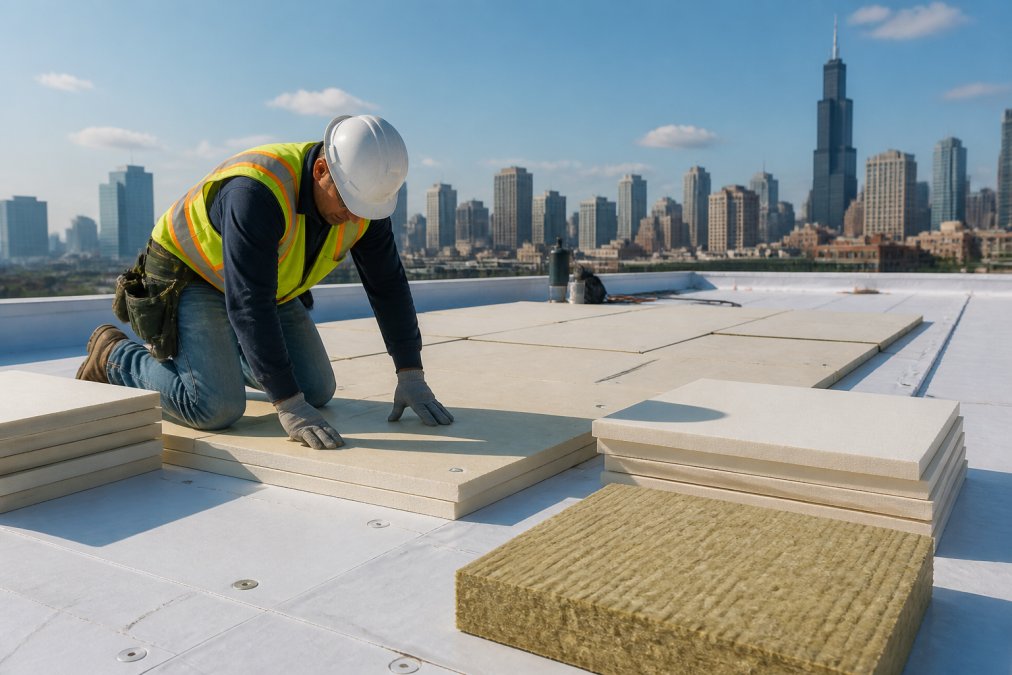
Polyiso delivers the most thermal resistance per inch, which matters when roof height or weight is limited. EPS costs less and performs well when dry, but loses thermal efficiency if moisture gets in. Mineral wool resists moisture and fire better than the other two, making it a strong pick for roofs with standing water or near fire-sensitive occupancies.
Comparing Thermal Performance and Moisture Resistance
Moisture is the deciding factor most owners overlook. Once insulation gets wet, its thermal performance drops and it can't dry out inside a sealed assembly. That's why a vapor retarder and proper drainage matter as much as the board you choose.
Commercial Roof Energy Efficiency Standards and Code Compliance
Commercial roof energy efficiency standards come from energy codes that set minimum insulation levels by climate zone, and compliance is not optional. Meeting them protects you during inspections, insurance reviews, and future resale.
The U.S. Department of Energy maintains building energy codes program resources that explain how commercial energy codes are adopted and enforced. Because adoption happens at the state and local level, the code edition in force varies by jurisdiction, and local amendments are common.
For property managers, the takeaway is simple: confirm the enforced code before you buy materials. A roof installed to an outdated standard can fail inspection and force costly corrective work.
Moisture Control, Condensation Prevention, and Mold Resistance
Moisture control is where most commercial roof problems start. Warm air holds more water vapor than cold air. When warm, moist interior air migrates upward into the roof assembly and reaches a surface at or below its dew point, that vapor condenses into liquid water. In a commercial roof, the condensing surface is often the underside of the roof deck or the membrane itself on a cold night.
Two things drive vapor migration: the vapor pressure difference between inside and outside, and the assembly's resistance to vapor flow. Insulation alone does not stop vapor, it slows heat, keeping surfaces warmer and pushing the dew point closer to the exterior. That is why vapor retarder placement relative to the insulation matters as much as the R-value.
Vapor Retarders, Air Barriers, and Where They Belong
A vapor retarder limits vapor diffusion through the assembly. The industry classifies them by permeance: Class I (≤0.1 perm, essentially impermeable, e.g., polyethylene or foil facers), Class II (0.1-1.0 perm, e.g., some kraft facers), and Class III (1.0-10 perm, e.g., most latex paints and some building wraps). An air barrier is a different function, it stops bulk air movement, which carries far more moisture than diffusion. A single material can serve both roles, but specifying one does not automatically give you the other.
In most climate zones, the vapor retarder belongs on the warm side of the insulation, interior in heating-dominated climates, exterior in cooling-dominated climates. In mixed climates, placement depends on the assembly and is often handled with a Class II or Class III retarder that can dry in both directions rather than a Class I sheet that traps moisture.
How Insulation Choice Affects Moisture Performance
Once insulation gets wet, its thermal performance drops, wet EPS and polyiso lose R-value, and because the assembly is sealed, the moisture cannot easily dry out. Mineral wool tolerates moisture without losing structural integrity and can drain and dry, which is why it is often specified for roofs with standing water, high interior humidity, or fire-sensitive occupancies.
Polyiso and EPS need a well-sealed assembly, a correctly placed vapor retarder, and positive drainage to stay dry. The goal is always the same: keep bulk water out, let anything that gets in drain away, and keep interior surfaces above the dew point so vapor never condenses.
Mold, Mildew, and the Cost of Getting It Wrong
Mold and mildew need three things: moisture, organic material, and moderate temperatures. A dry roof assembly will not support mold growth, even with a wood deck or paper-based facer. A wet one will, and the problem is usually invisible from the roof surface, you find it when a ceiling stain appears, a fastener corrodes through, or an inspection pulls back the membrane and finds saturated insulation.
By the time mold is visible inside, the roof assembly has typically been wet for months. That is why moisture control is a design decision, not a maintenance task: the vapor retarder, insulation type, drainage slope, and flashing details must work together from day one. A roof designed to stay dry resists mold, corrosion, and premature failure.
Retrofitting vs. New Construction: Insulation Strategies That Work
Retrofitting and new construction call for different insulation strategies, and treating them the same is a costly mistake. New builds let you specify thickness, layering, and vapor control from the start. Retrofits force you to work around existing deck height, drainage slope, and load limits.
On a retrofit, adding insulation on top of the existing roof, a recover, can raise R-value without a full tear-off, but only if the existing assembly is dry and structurally sound. If there's trapped moisture, you're sealing the problem in.
For new construction, you can hit higher R-values, stagger board joints, and design the slope correctly from day one; the trade-off is upfront cost versus long-term performance. On retrofits, the trade-off is speed and disruption versus how much you can realistically improve.
Both paths benefit from a building envelope designed as a system, not a stack of unrelated parts. When insulation, vapor retarder, and membrane work together, the roof performs as intended.
Commercial roof insulation is one of the few building investments that pays back through lower energy bills, fewer repairs, and a longer-lasting roof. Getting it right takes a contractor who understands climate zones, code minimums, and material trade-offs, not just membrane installation. Certified Roofing Solutions Inc. brings an experienced team to every commercial and residential project, with roofing solutions tailored to each building's needs and a commitment to exceptional results. If your commercial roof is due for an upgrade or you're planning new construction, book an appointment with Certified Roofing Solutions Inc. and get an insulation strategy built for your building.
Frequently Asked Questions
What are the benefits of commercial roof insulation?
Commercial roof insulation lowers energy costs by reducing heat transfer through the building envelope, which cuts HVAC load and energy consumption. It also prevents condensation that can lead to mold and structural damage, extends the life of the roof membrane by reducing thermal shock, and helps meet building codes and energy efficiency standards. For property managers in Marietta, Alpharetta, Dunwoody, and Johns Creek, proper insulation is one of the highest-ROI upgrades for any commercial roof system.
What is the recommended R-value for commercial roof insulation?
R-value requirements depend on your climate zone and local building codes. The exact minimum varies by code edition and building type. The International Energy Conservation Code sets baseline requirements that many jurisdictions adopt. Always confirm with your local code official or a licensed roofing professional, because under-insulating can fail inspection and over-insulating without proper design can trap moisture.
Does roof insulation prevent condensation in commercial buildings?
Insulation alone does not stop condensation, but a properly designed roof assembly with insulation, a vapor retarder, and adequate ventilation dramatically reduces the risk. When warm, moist air meets a cold roof deck, condensation forms and can saturate insulation, corrode metal components, and feed mold growth. The key is placing insulation and vapor retarders in the correct layers for your climate zone so the dew point stays outside the building envelope.
How long does commercial roof insulation last?
Most commercial roof insulation lasts 20 to 30 years when installed correctly and kept dry. Polyisocyanurate and mineral wool boards hold up well, but moisture infiltration is the main threat. Once insulation gets wet, its R-value drops and it may need replacement. Regular roof inspections and prompt repair of membrane punctures or flashing failures are the best way to protect insulation and avoid premature replacement costs.