 ultimate-guide
What Causes Commercial Roof Leaks: 2026 Guide
Table of Contents
- 7 Common Causes of Commercial Roof Leaks
- Membrane and Seam Failure
- Flashing and Penetration Problems
- Drainage Issues and Pooling Water
- Signs of Commercial Roof Failure You Should Never Ignore
- How Commercial Roof Inspection Frequency Prevents Leaks
- Your Commercial Roof Maintenance Checklist for Every Season
- When to Repair vs. Replace a Leaking Commercial Roof
- The Hidden Costs of Ignoring Commercial Roof Leaks
- Frequently Asked Questions
Last Updated: September 10, 2026
7 Common Causes of Commercial Roof Leaks
Commercial roof leaks rarely come from a single dramatic failure. They build slowly, often from several small problems compounding over years. This guide from Certified Roofing Solutions Inc. breaks down what causes commercial roof leaks so property managers can spot trouble before it reaches the ceiling tiles.
Below, we cover the seven most common culprits, the warning signs that demand attention, and how a maintenance schedule keeps water where it belongs.
Membrane and Seam Failure
Flat roof membranes take constant punishment from sun, temperature swings, and foot traffic. Over time, the material weakens and seams separate.
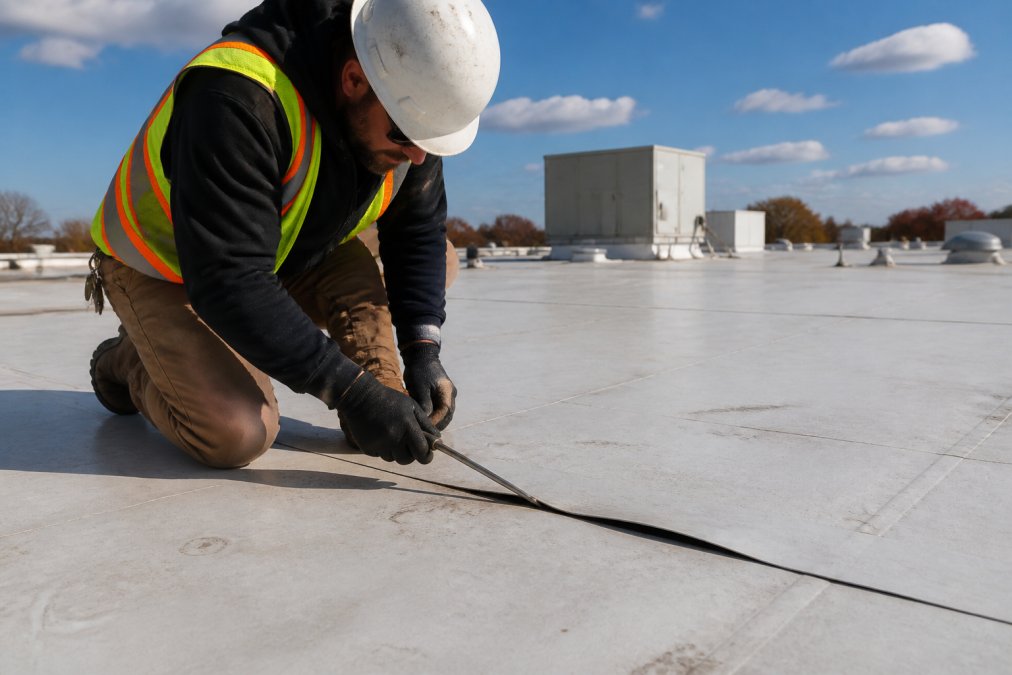
Single-ply systems like TPO and EPDM rely on heat-welded or adhesive seams. When those seams fail, water slips underneath the membrane and travels far from the original breach. A common mistake is patching the visible stain inside the building instead of tracing the leak to its source on the roof.
Aging materials make this worse. As membranes approach the end of their service life, they lose flexibility and develop cracks, blisters, and shrinkage. Once the membrane pulls away from the substrate, moisture infiltration accelerates.
Flashing and Penetration Problems
Every opening in a commercial roofing system is a potential leak point. Flashing seals the edges where the roof meets walls, curbs, and equipment, and it fails more often than the field of the membrane itself.
Roof penetrations include HVAC curbs, vent pipes, exhaust fans, and conduit supports. Each one depends on sealants and boots that degrade under UV radiation and thermal expansion. When sealant cracks, water follows the penetration straight into the building envelope.
Parapet walls deserve special attention. The joint where the wall meets the roof deck flexes constantly, and poor flashing detail there is one of the most frequent sources of commercial roof leaks. Metal counterflashing that has pulled loose or rusted through offers no protection at all.
Drainage Issues and Pooling Water
Standing water is the quiet killer of commercial roofing systems. If water sits on the membrane for more than 48 hours after a storm, the roof has a drainage problem (nrc-cnrc.gc.ca).
Clogged gutters, scuppers, and internal drains top the list. Debris from nearby trees, hail impact, and even bird nests block the flow path. When drains back up, water pools in low spots, adding weight and stressing the structural integrity of the deck.
Pooling water also accelerates membrane degradation. Chemicals and contaminants concentrate in standing water, breaking down waterproofing and feeding algae growth. Regular drain clearing is one of the simplest preventative maintenance tasks a property manager can schedule.
Signs of Commercial Roof Failure You Should Never Ignore
Recognizing the signs of commercial roof failure early saves thousands in interior repairs. Watch for these indicators:
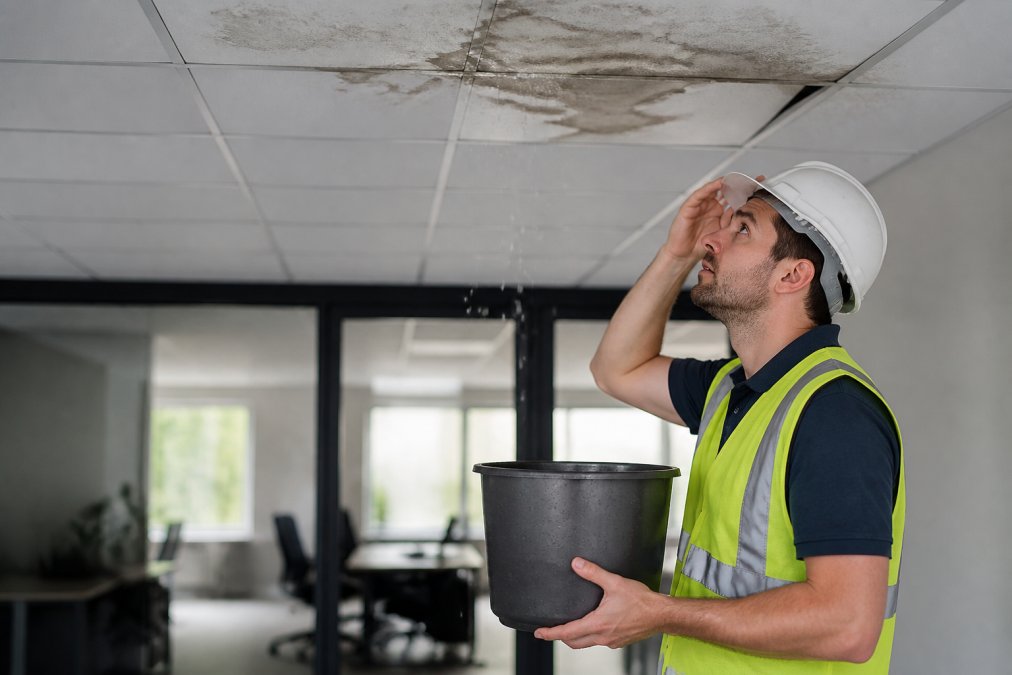
- Water stains on ceiling tiles or walls, especially after heavy rain
- Musty odors in upper floors indicating trapped moisture
- Blistered, cracked, or wrinkled membrane surfaces
- Visible ponding water that lingers more than two days
- Rusted fasteners, loose flashing, or deteriorated sealants
- Sagging deck areas or visible deflection
- Daylight showing through the roof deck from inside
Any single sign warrants a professional inspection. Multiple signs together usually mean the roof is nearing the end of its useful lifespan.
How Commercial Roof Inspection Frequency Prevents Leaks
Commercial roof inspection frequency should be at least twice a year, with additional checks after major storms. This schedule catches small problems before they become structural issues.
A typical inspection covers membrane condition, seam integrity, flashing, drainage, and penetrations. Inspectors also check for mechanical damage from foot traffic and rooftop equipment. Infrared thermography can reveal moisture trapped beneath the membrane that isn't visible on the surface.
| Inspection Type | Frequency | Primary Focus |
|---|---|---|
| Routine visual | Twice yearly | Membrane, flashing, debris |
| Post-storm | After each major event | Hail impact, wind uplift, punctures |
| Infrared scan | Annually | Hidden moisture, insulation saturation |
| Drain and gutter clearing | Quarterly | Pooling water, clogged drains |
Documenting each inspection with photos and notes matters more than most managers realize. That record becomes essential when filing an insurance claim for storm damage.
Your Commercial Roof Maintenance Checklist for Every Season
A commercial roof maintenance checklist keeps small tasks from becoming expensive emergencies, but the real value is not the cleaning itself. It is the documentation trail the checklist produces. Most commercial property insurance carriers expect evidence of routine maintenance when a storm-damage claim is filed, and a dated, photographed checklist is the simplest way to provide it.
Build the checklist around the roof system you actually have, then run it on a fixed calendar.
Spring
- Clear winter debris from drains, scuppers, and gutters. Confirm every drain flows freely by running water and watching the outlet.
- Inspect flashing and sealants for freeze-thaw cracking, especially at parapet walls and equipment curbs.
- Check for loose fasteners and lifted seam edges after winter wind events.
- Photograph any new blisters, wrinkles, or ponding areas and note the date.
Summer
- Look for UV damage: chalking, granule loss on modified bitumen, and membrane shrinkage on TPO.
- Verify HVAC curbs, vent boots, and conduit penetrations are sealed. Rooftop units vibrate, and vibration opens sealant joints over time.
- Trim overhanging tree branches that drop debris or scrape the membrane.
- Log any interior ceiling stains and match them to roof locations while the weather is dry.
Fall
- Remove fallen leaves before they clog drains and before the first freeze.
- Inspect seams and flashing ahead of freeze-thaw cycling, which is when small openings become active leaks.
- Schedule coatings, repairs, and any torch-applied work while temperatures are still within manufacturer limits.
- Confirm the winter emergency contact and snow-removal plan is in place.
Winter
- Watch for ice dams at eaves, drains, and parapet walls, and for snow load that exceeds the deck's design capacity.
- Avoid foot traffic on frozen membranes, which crack easily under concentrated weight.
- Clear ice from drain openings where it is safe to do so; never chip at the membrane.
- Document any new leaks immediately, with photos and a written description, before interior damage spreads.
Documentation that supports an insurance claim
Every checklist entry should produce three things: a date, a photo, and a one-line note describing what was observed and what was done. Keep the record in a single file organized by date. When a storm claim is filed, that file shows the carrier that the roof was maintained, which strengthens the claim and speeds adjustment. It also establishes a baseline so that new damage can be distinguished from pre-existing wear, which is the single most common point of dispute in commercial roof claims.
When to Repair vs. Replace a Leaking Commercial Roof
The repair-versus-replace decision hinges on roof age, extent of damage, recurrence pattern, and the specific failure mode of the membrane system. A single isolated leak on a roof under ten years old usually calls for a targeted repair. Replacement makes more sense when repairs exceed roughly a quarter to a third of the roof area, when leaks return in multiple locations within a single season, or when the membrane is past its expected service life.
Material choice drives the calculus. Each commercial membrane system fails in characteristic ways, and knowing which failure mode you are looking at tells you whether a repair will hold or simply buy time.
TPO (thermoplastic polyolefin): Heat-welded seams are the system's strength and its most common failure point. When weld temperatures or speeds are off during installation, seams can separate years later. TPO also shrinks as plasticizers migrate out, pulling away from walls and curbs and stressing flashing details. Field repairs on TPO are reliable when the surrounding membrane is still flexible; once widespread shrinkage appears, patching becomes a losing game.
EPDM (ethylene propylene diene monomer): This thermoset rubber is joined with adhesive or tape, and seam failure is the dominant leak source. EPDM also suffers from punctures, animal damage, and shrinkage at the perimeter. Because EPDM is not heat-weldable, repairs rely on primer and cover tape, which can fail again if surface prep is poor.
Modified bitumen: These asphalt-based sheets are torch-applied or self-adhered. Common failure modes include blistering from trapped moisture, granule loss from UV exposure, and open laps where the seam edge lifts. Modified bitumen can often be resurfaced with a coating or a cap sheet rather than torn off, which changes the repair-vs-replace math considerably.
Metal roofing: Standing-seam panels fail at fasteners, sealants, and panel laps rather than the field of the panel itself. A metal roof with isolated fastener back-out is a repair; widespread corrosion or failed butyl tape at every lap points toward replacement or a retrofit system.
A few practical thresholds help property managers decide:
- Repair when damage is localized, the membrane is under two-thirds of its expected service life, and the underlying insulation is dry.
- Restore or recoat when the membrane is sound but weathered, and the goal is to extend life a few years before a planned capital replacement.
- Replace when moisture has saturated the insulation across a large area, when the deck itself shows deflection or corrosion, or when repair costs over a rolling 24-month window approach the cost of a new system.
A roofing professional can assess whether a coating, a partial replacement, or a full tear-off fits the building's needs and budget. Ask for a written assessment that separates urgent repairs from items that can wait, and that ties each recommendation to a specific observed failure mode. That breakdown helps property managers plan capital spending instead of reacting to emergencies.
The Hidden Costs of Ignoring Commercial Roof Leaks
The visible cost of a roof leak is the repair bill. The hidden costs run much higher.
Moisture infiltration damages insulation, drywall, ceiling systems, and sometimes electrical infrastructure. Wet insulation loses its R-value, which drives up energy costs across the whole building (energy.gov). Mold growth creates health and liability risks that can shut down tenant spaces (the CDC).
Business interruption is the cost owners feel most. A leak above a retail floor or office suite forces closures, disrupts tenants, and can trigger lease disputes. Safety hazards from wet floors and compromised ceiling structures add further liability.
Insurance claim documentation becomes far harder when damage accumulates over months instead of being reported promptly. Carriers scrutinize delayed claims, and undocumented maintenance history weakens a claim.
Commercial roof leaks rarely announce themselves. They start as a cracked sealant bead, a clogged drain, or a seam that quietly separates, then escalate into structural and financial problems. At Certified Roofing Solutions Inc., our team handles commercial inspections, TPO and metal roofing work, and preventative maintenance programs built around each building's needs. We document every inspection and explain repair-versus-replace options in plain terms. Book an appointment today and get a clear picture of your roof's condition before the next storm finds the weak spot.
Frequently Asked Questions
What are the most common causes of commercial roof leaks?
The most common causes of commercial roof leaks include membrane and seam failure, flashing damage around penetrations, clogged drains that lead to pooling water, and thermal expansion and contraction that loosens fasteners and sealants. Wind uplift, hail impact, and foot traffic also create openings. Regular inspections catch these issues before water enters the building envelope.
How often should commercial roofs be inspected for leaks?
Commercial roofs should be inspected at least twice a year, ideally in spring and fall. Buildings in areas with severe weather, heavy foot traffic, or rooftop equipment may need quarterly inspections. After any major storm, schedule an inspection immediately. Following a commercial roof maintenance checklist during each visit helps you track small problems before they become expensive repairs.
Can ponding water cause structural damage to a commercial roof?
Yes. Water that stands on a flat roof for more than 48 hours after rain adds significant weight and stresses the structure. Over time, ponding water breaks down the roof membrane, accelerates seam failure, and can lead to sagging or even collapse. Proper roof drainage, including clear scuppers and drains, is critical to preventing this damage.
Does lack of maintenance lead to commercial roof failure?
Lack of maintenance is a leading cause of premature commercial roof failure. Debris left on the roof clogs drains, small punctures go unrepaired, and sealants dry out. These small issues let moisture infiltrate the roofing system, reducing its lifespan by years. A consistent maintenance plan and regular inspections are the most cost-effective ways to protect your investment.