 blog
blog
Is TPO Roofing Worth It for Small Businesses? 2026 Guide
Table of Contents
- What TPO Roofing Actually Is (and Why Small Businesses Care)
- TPO vs EPDM Roofing Cost: Which One Fits Your Budget?
- The Real Pros and Cons of TPO Roofing
- Why Some TPO Roofs Fail (and How to Avoid It)
- Your Commercial Roof Maintenance Checklist
- Commercial Roofing Warranty Standards: What Small Businesses Should Expect
- Calculating ROI: When TPO Roofing Makes Financial Sense
- Frequently Asked Questions
Last Updated: September 12, 2026
What TPO Roofing Actually Is (and Why Small Businesses Care)
TPO roofing is a single-ply membrane made from thermoplastic polyolefin, a heat-welded sheet material designed for flat and low-slope commercial roofs. For a small business owner weighing a roof replacement, the practical question is not what the polymer is called but whether the membrane survives a decade of sun, storms, and foot traffic without draining your maintenance budget. This guide walks through the real cost drivers, failure points, and ROI math so you can decide with numbers instead of sales pitches.
Here's the tension most articles skip: TPO has a reputation problem in contractor forums, and much of it traces back to installation quality rather than the material itself.
The single-ply membrane explained in practical terms
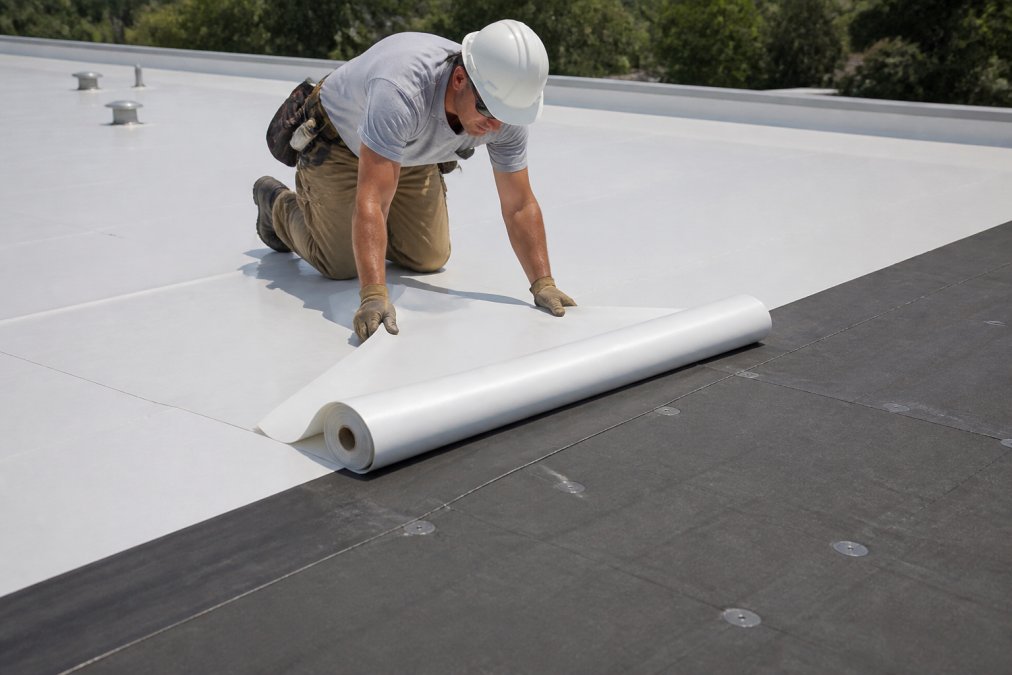
A single-ply membrane means one layer of waterproofing material covers the roof deck, rather than the overlapping shingle courses you see on pitched residential roofs. TPO sheets arrive in wide rolls, get rolled out across the flat roof, and are joined at the seams with hot-air welding. The ASTM International standards for thermoplastic roofing membranes define the thickness and physical property benchmarks manufacturers build to.
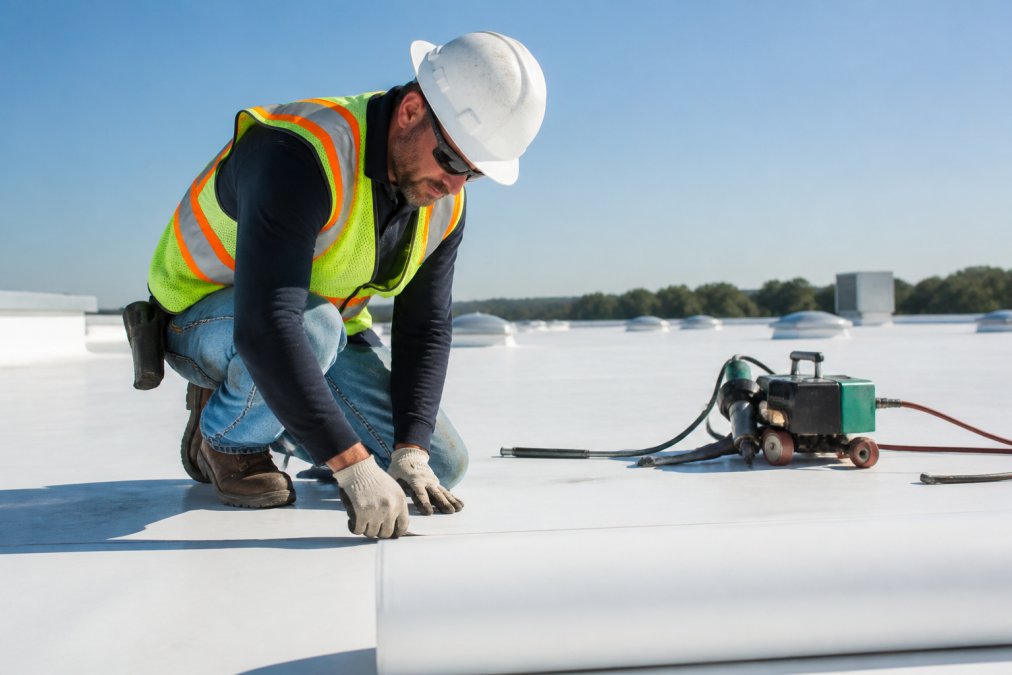
That welded seam is the whole ballgame. A properly fused seam forms a bond stronger than the sheet itself; a cold or rushed seam becomes the leak point two winters later.
Where TPO fits in low-slope commercial roofing
Low-slope roofing covers any roof pitched at a shallow angle where water drains slowly rather than shedding fast. Warehouses, retail strips, office buildings, and multi-unit properties all fall into this category. TPO competes in that space against EPDM rubber and modified bitumen, and it wins on reflectivity and seam strength while losing on puncture tolerance.
For a property manager overseeing a flat roof, the material choice usually comes down to three variables: upfront cost, expected roof lifespan, and how much maintenance the building envelope will demand.
TPO vs EPDM Roofing Cost: Which One Fits Your Budget?
The honest answer on TPO vs EPDM roofing cost is that both land in a similar installed range, and the deciding factor is usually building use rather than sticker price. Exact figures vary by roof size, deck condition, insulation requirements, and regional labor rates, so any contractor quoting a number before inspecting your roof is guessing. Ask for a written scope that separates membrane, insulation, tear-off, and labor.
| Factor | TPO Membrane | EPDM Membrane |
|---|---|---|
| Seam method | Hot-air welded | Adhesive or tape |
| Reflectivity | High, heat-reflective surface | Low, typically black |
| Puncture resistance | Moderate | Higher |
| Typical lifespan | 15-25 years | 20-30 years |
| Best for | Cooling-load-heavy buildings | Harsh hail or debris exposure |
The Real Pros and Cons of TPO Roofing
TPO's strengths cluster around energy performance and seam reliability. Its weaknesses cluster around physical toughness and the quality of the crew that installs it.
What TPO does well: energy efficiency, UV resistance, and seam integrity
The heat-reflective white surface bounces solar radiation instead of absorbing it, which lowers rooftop surface temperature and reduces the cooling load pushed onto your HVAC system. UV resistance keeps the membrane from chalking and cracking the way older asphalt products do. Hot-air welded seams create a continuous, leak-resistant barrier that resists water migration far better than adhesive joints.
Where TPO falls short: puncture resistance, thermal expansion, and installation quality
TPO is thinner and softer than EPDM, so dropped tools, hail, and rooftop foot traffic puncture it more easily. The membrane also expands and contracts with temperature swings, and if the installer doesn't account for that movement at the perimeter and penetrations, the sheet can pull and tear. Poor installation, not the material, causes the majority of premature failures.
Why Some TPO Roofs Fail (and How to Avoid It)
Most articles treat TPO failure as a single event. In practice, failures split into two distinct categories, seam and termination failure, which is an installation defect, and membrane degradation, which is a material and exposure issue, and the fix for each is different. Knowing which one you're looking at determines whether you call the installer or the manufacturer.
Seam and termination failure: the installation defect
Hot-air welded seams are TPO's greatest strength and its most common failure point, because the weld is only as good as the temperature, speed, and pressure the installer applied. A seam welded too cold or pulled too fast forms a bond that looks continuous but peels apart under thermal cycling. A seam welded too hot scorches the membrane and creates a brittle edge that cracks.
The warning signs appear before the leak does. Look for seams that have lifted at the edge, a visible dark line running along the weld, or membrane that feels stiff and glossy rather than pliable. Probing the seam with a dull tool, a standard quality check, should meet firm resistance; if the probe slides between the sheets, the weld failed.
Termination failure follows the same logic at the roof perimeter and around penetrations. TPO expands and contracts with temperature swings, and if the sheet wasn't mechanically fastened or terminated with enough slack to accommodate that movement, it pulls away from the edge, the curb, or the pipe boot. That is why the perimeter and every rooftop penetration deserve a second look during inspection, not just the field of the roof.
Membrane degradation: the material and exposure issue
Material degradation is slower and less common than seam failure, but it is real. Prolonged ponding water, standing water that hasn't drained 48 hours after rain, stresses the membrane and accelerates the breakdown of the surface. Unprotected rooftop traffic grinds dirt and grit into the sheet and punctures it. Hail and dropped tools leave damage that goes unnoticed until water finds it.
A common pattern is that premature failures cluster on roofs where two or three of these conditions overlap: a rushed installation, no maintenance program, and heavy foot traffic from HVAC service. The material rarely fails on its own.
How to prevent premature failure
Prevention comes down to three controls, and all three are things a small business owner can verify rather than take on faith.
- Verify the weld, don't assume it. Ask the contractor how they test seam integrity, probing, air lance, or peel test, and whether they document the results. A crew that can't describe its seam testing is a crew that isn't doing it.
- Confirm the specification matches the bid. Membrane thickness, fastener spacing, and insulation attachment are spelled out by the manufacturer. A bid that comes in well below others usually means one of those was cut.
- Inspect on a schedule, not after a leak. Twice-yearly inspections catch lifted seams and early punctures while they're still cheap to repair. The maintenance checklist below covers what to look for.
Your Commercial Roof Maintenance Checklist
A commercial roof maintenance checklist turns a reactive repair habit into a predictable schedule. Small businesses that inspect twice a year catch small problems before they become interior water damage.
- Inspect seams and flashings for separation or lifting
- Clear drains, scuppers, and gutters of debris
- Check for ponding water 48 hours after rain
- Walk the membrane for punctures and blisters
- Verify rooftop equipment curbs are sealed
- Photograph and log any new damage for warranty records
- Schedule professional inspection before and after storm season
Commercial Roofing Warranty Standards: What Small Businesses Should Expect
Commercial roofing warranty standards split into two types, and confusing them costs building owners money. A material warranty covers only the membrane the manufacturer sold (nrca.net). A labor and workmanship warranty covers the installation itself, which is where most failures originate.
Read the exclusions carefully. Many warranties void coverage if maintenance lapses, if another trade punctures the roof, or if ponding water is left unaddressed. The National Roofing Contractors Association guidance on roof warranties recommends documenting the full system specification so claims aren't disputed later. Ask your contractor which warranty type they provide and what maintenance it requires.
Calculating ROI: When TPO Roofing Makes Financial Sense
Most articles tell you TPO "pays for itself through energy savings" and stop there. That's not a calculation, it's a slogan. Here is a framework a small business owner can actually run, using their own numbers, to decide whether the investment clears the bar.
The four inputs you need
You don't need a spreadsheet to start. You need four figures, and three of them are already in your records.
- Installed cost. The full project cost, not the membrane price, membrane, insulation, tear-off or overlay, fasteners, labor, and any deck repair. Ask for a written scope that separates each line so you can compare bids honestly.
- Annual energy savings. The reduction in cooling cost from the reflective surface. Your utility bills from the last two summers give you the baseline; a reflective white membrane typically lowers rooftop surface temperature enough to reduce the cooling load, but the actual savings depend on your insulation, HVAC efficiency, and climate.
- Avoided repair costs. What you currently spend per year patching leaks, plus the interior damage those leaks cause. If you've had two repairs in the last three years, average them.
- Ownership horizon. How many years you expect to own or operate the building. This is the input most owners get wrong, and it's the one that decides the answer.
Running the payback math
The formula is simple: installed cost ÷ (annual energy savings + annual avoided repair costs) = payback period in years.
Say a small business spends $18,000 on a TPO replacement, saves $1,200 a year on cooling, and avoids $800 a year in patch repairs. That's $2,000 in annual benefit, so the payback period is nine years. If the owner plans to hold the building for fifteen years, the roof clears the bar with six years of benefit left. If they plan to sell in five, it doesn't, and a patch-and-monitor approach may deliver better value.
The payback period is the number to compare against your ownership horizon. If payback lands inside the horizon, replacement usually wins. If it lands outside, the math favors deferral.
The costs the formula leaves out
Two factors can swing the decision and rarely appear in a simple payback calculation.
- Warranty value. A material warranty plus a labor and workmanship warranty shifts repair risk off your books for the covered term. That's worth something even if it never shows up on a utility bill.
- Business interruption. A leak over a retail floor or an office ceiling costs more than the repair, it costs lost operating days. A leak-resistant system reduces that exposure, and for some businesses that risk alone justifies the upgrade.
When the math favors TPO, and when it doesn't
TPO tends to clear the bar for small businesses with high summer cooling costs, a flat or low-slope roof at or near the end of its service life, and a long-term ownership plan. It tends to fall short for buildings with mild cooling demand, a short ownership horizon, or a roof with years of service remaining. Run the four inputs before you decide; the answer is usually obvious once the payback period is on paper.
Frequently Asked Questions
What are the downsides of TPO roofing?
TPO has a few known weaknesses. It can be punctured by dropped tools or foot traffic, and seams can fail if the installer does not control heat and pressure during hot-air welding. Thermal expansion and contraction also stress the membrane over time. Some older formulations were prone to premature cracking, though current products have improved. Most failures trace back to installation quality rather than the material itself, so choosing an experienced roofing contractor matters more than the brand of membrane.
How does TPO roofing compare to EPDM in terms of cost?
TPO and EPDM sit in a similar price bracket, but the installed cost depends on membrane thickness, insulation, fastening method, and local labor. EPDM often has a lower material cost, while TPO can reduce long-term energy expenses because of its heat-reflective surface. For small businesses weighing TPO vs EPDM roofing cost, the deciding factor is usually climate: TPO performs better in high-UV and hot regions, while EPDM holds up well in colder markets. Request a written quote that breaks out material and labor separately.
Is TPO roofing energy efficient for small business facilities?
Yes. TPO's reflective surface bounces sunlight away from the building, which lowers cooling loads during summer. That matters for small businesses with warehouse, retail, or office space where HVAC costs eat into margins. Energy savings vary by climate, insulation, and building size, so ask your roofing contractor to calculate expected savings based on your specific roof assembly. Pairing TPO with proper insulation delivers the biggest impact on monthly utility bills.
What maintenance is required to keep a TPO roof under warranty?
Most manufacturers require semi-annual inspections, prompt repair of any punctures or seam issues, and documented cleaning of drains and debris. Keep records of every inspection and repair, because warranty claims get denied when maintenance logs are missing. A commercial roof maintenance checklist should include checking seams, flashing, and penetrations after every major storm. Small businesses that follow the manufacturer's maintenance schedule typically get the full warranty term, which can run 15 to 20 years.