 blog
How to Choose Roofing Materials That Cut Cooling Costs
Last Updated: October 27, 2026
Quick Summary
The best roofing materials for reducing cooling costs are metal, cool-roof asphalt shingles, tile, and slate, because they reflect solar radiation and release absorbed heat quickly. Metal and light-colored tile perform best, while cool-roof shingles offer the simplest budget retrofit.
- Your roof absorbs solar radiation all day and releases that heat into your attic and living space.
- Solar Reflectance Index (SRI) is a 0-to-100+ score defined under ASTM E1980 for comparing surfaces.
- Ask for the aged SRI rather than the initial value, since dust and weathering lower reflectance over time.
- Payback in years equals extra upfront cost divided by annual cooling savings.
- The best roof color for energy efficiency is almost always a light one, such as white, light gray, or tan.
Table of Contents
- Why Your Roof Drives Summer Cooling Costs
- Energy-Efficient Roofing Materials Compared
- Metal Roof Energy Efficiency: What the Numbers Show
- The Best Roof Color for Energy Efficiency
- Energy-Efficient Roof Cost and Payback
- Matching Materials to Your Climate and Whole-Roof Assembly
- Book a Roof Assessment and Get Your Cooling-Savings Plan
- Frequently Asked Questions
Why Your Roof Drives Summer Cooling Costs
Your roof is the largest surface your home presents to the sun, and it absorbs solar radiation all day before releasing that heat into your attic and living space. That trapped heat forces your air conditioning to run longer and harder.
Cooling costs are the portion of your energy bill spent removing heat that enters through the building envelope.
Below, we compare the leading options and show how each one performs. For the big-picture guide to energy-efficient roofing and lowering utility bills, start there before diving into material comparisons.
Energy-Efficient Roofing Materials Compared
The best roofing materials for reducing home cooling costs are those that reflect solar radiation and release absorbed heat quickly. Four families lead the pack: metal, cool-roof asphalt shingles, tile, and slate. Each performs differently, costs differently, and suits a different kind of home.
Metal Roofing: Aluminum and Steel
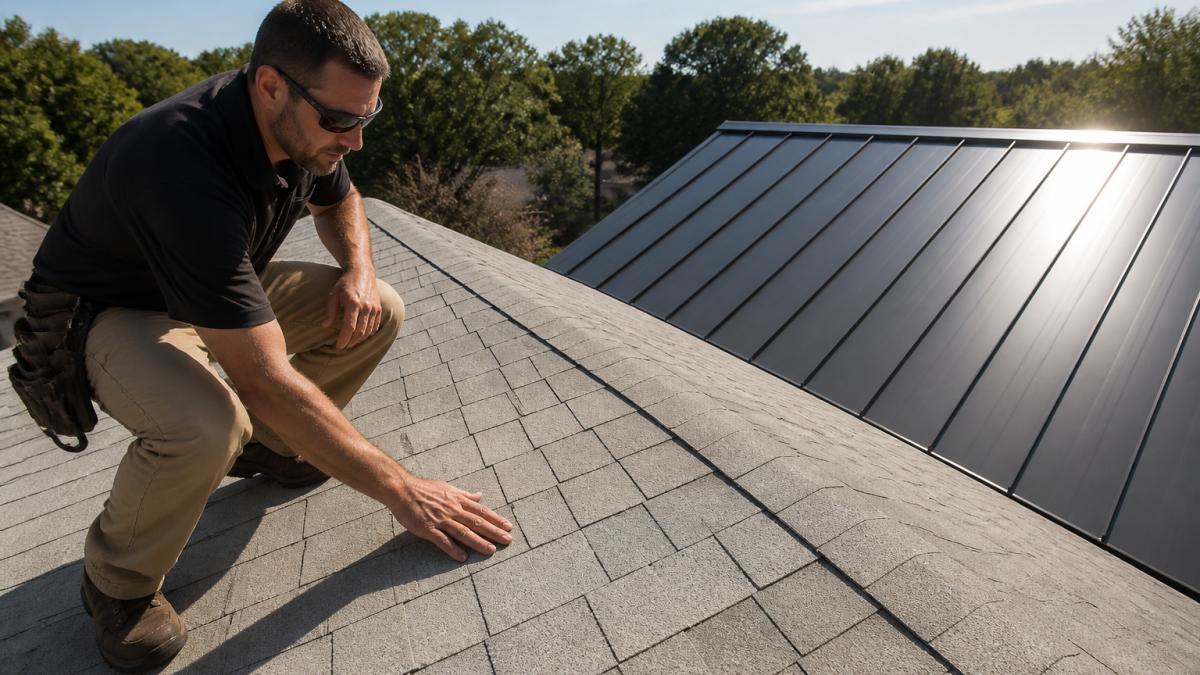
Metal roofing reflects a large share of solar radiation and sheds heat fast, so the roof surface stays cooler than asphalt under the same sun. Aluminum resists corrosion well in humid conditions; steel is stronger and often carries a longer finish warranty. Both come in reflective coatings and light colors that push performance higher. The trade-off is upfront cost, which runs well above asphalt.
Cool-Roof Asphalt Shingles
Cool-roof shingles use reflective granules that bounce solar radiation back instead of absorbing it. They install like standard asphalt, cost far less than metal, and are the simplest retrofit for an existing shingle roof. They will not match metal's heat performance, but they close much of the gap for a fraction of the price.
Tile Roofing and Slate Tiles
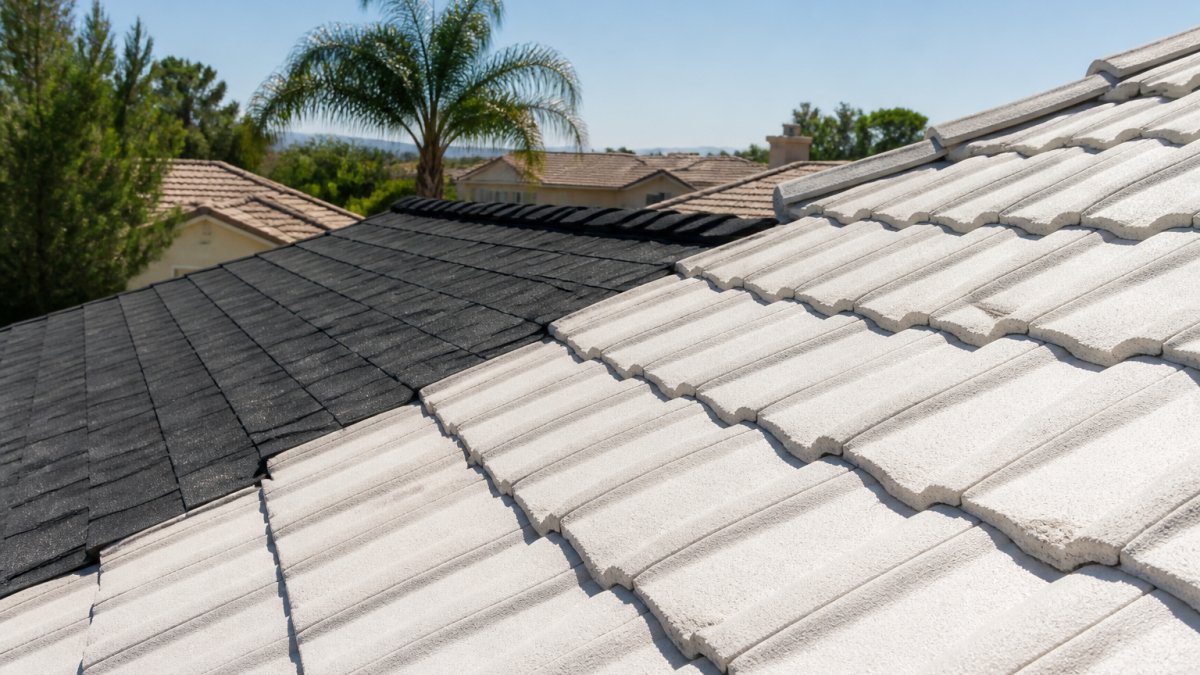
Tile and slate both handle heat well because of mass and airflow beneath the surface. Clay and concrete tile create an air gap that keeps heat away from the deck, and light-colored tile reflects strongly. Slate offers excellent heat resistance and a very long lifespan, but it is heavy and expensive, and not every structure can carry it.
| Material | Reflectivity | Relative Upfront Cost | Heat Performance | Best For |
|---|---|---|---|---|
| Metal (aluminum/steel) | High | High | Excellent | Long-term owners, hot climates |
| Cool-roof shingles | Moderate to high | Low to moderate | Good | Budget retrofits |
| Tile | High when light-colored | Moderate to high | Very good | Hot, dry climates |
| Slate | Moderate | Very high | Very good | Premium, long-horizon homes |
Metal Roof Energy Efficiency: What the Numbers Show
Metal roof energy efficiency comes down to two measurable surface properties, and understanding them is the difference between a marketing claim and a number you can compare across products.
Solar reflectance (often written as the initialism for solar reflectance) is the fraction of incoming sunlight a surface bounces back, expressed from 0 to 1. Thermal emittance is the fraction of absorbed heat the surface radiates away, also 0 to 1.
Those two properties combine into the Solar Reflectance Index (SRI), a single 0-to-100+ score defined under ASTM E1980. Higher SRI means a cooler surface under the same sun. SRI is the number to ask for on a product data sheet, and it is the number that lets you compare a coated steel panel against a reflective shingle on equal footing rather than by color alone.
Why metal runs cooler than asphalt
The mechanism is straightforward. Asphalt shingles are dark, absorptive, and low-mass; they soak up solar radiation and conduct heat down through the deck into the attic. A pre-painted metal panel with a cool coating reflects a large share of that radiation at the surface, and the small amount it does absorb is released quickly because metal is thin and highly conductive. The result is a lower roof surface temperature and a smaller heat load pushed into the attic.
Reading the numbers honestly
A few cautions keep the numbers useful:
- SRI is a surface rating, not a savings guarantee. It tells you how hot the surface will run relative to a black reference, not how many dollars you will save.
- Aged ratings matter more than initial ratings. Dust, pollen, and weathering lower reflectance over time. Ask for the aged (weathered) SRI, not just the initial value.
- The assembly sets the ceiling. A high-SRI panel over a leaky, under-insulated attic will underdeliver. Reflectance reduces the heat entering the roof; insulation and air sealing control how much of that heat reaches your living space.
The Best Roof Color for Energy Efficiency
The best roof color for energy efficiency is almost always a light one. Light-colored roofs reflect more solar radiation, stay cooler, and reduce heat absorption into the attic. White, light gray, tan, and pale terracotta all outperform dark brown, charcoal, and black.
Energy-Efficient Roof Cost and Payback
Energy-efficient roof cost varies widely by material, roof size, pitch, and tear-off requirements, so a single national price would be misleading. What is useful is a framework for comparing installed cost against expected savings, service life, and maintenance, the lifecycle math that turns a big upfront number into a per-year figure you can actually judge.
The four inputs to any payback estimate
- Installed cost. Material plus labor plus tear-off plus any structural or underlayment work. Metal and tile sit at the high end; cool-roof shingles sit near standard asphalt.
- Annual cooling savings. Driven by climate, roof area, attic insulation and air sealing, duct location, and HVAC efficiency, not by the roof material alone.
- Service life. How many years the roof lasts before replacement, which spreads the upfront cost across decades.
- Maintenance and replacement. Coatings, fasteners, flashing, and eventual tear-off all carry future costs that a fair comparison includes.
A simple payback calculation
The basic formula is:
Payback (years) = Extra upfront cost ÷ Annual cooling savings
How the materials compare on lifecycle
- Metal carries the largest upfront cost but the longest service life and low maintenance, which lowers its effective annual cost over a long ownership horizon.
- Tile is similarly long-lived and low-maintenance, with weight and structural requirements adding to the upfront figure.
- Cool-roof shingles cost the least to install and deliver solid savings over a shorter service life, making them the easiest retrofit to justify on a short horizon.
- Slate has the highest upfront cost and the longest life; its payback depends on how long you own the home.
Matching Materials to Your Climate and Whole-Roof Assembly
Humidity matters too. In warm, humid conditions, ventilation and moisture control matter as much as reflectivity, because trapped moisture degrades decking and insulation. Match the material to your climate zone, then confirm the assembly behind it is sound. Our guide on how to choose the right roofing material for your climate walks through the decision.
Book a Roof Assessment and Get Your Cooling-Savings Plan
Certified Roofing Solutions Inc. provides residential and commercial roofing services tailored to meet the unique needs of each project.
Get started with Certified Roofing Solutions Inc.
Frequently Asked Questions
What roofing material keeps a house the coolest?
Metal roofing with a reflective coating, and white or light-colored tile, tend to keep a house coolest because they reflect solar radiation instead of absorbing it. Cool-roof asphalt shingles with reflective granules are a close option for homes that want a shingle look. The material matters, but so does the color and the attic ventilation underneath. A ventilated attic paired with a reflective surface lowers roof surface temperature more than either feature alone, which is why a full assembly assessment beats picking a material by name.
Do metal roofs reduce cooling costs?
They can, and metal roof energy efficiency depends heavily on the coating and color. Bare metal absorbs heat; a reflective painted finish or a granulated surface pushes solar radiation back. Metal also sheds heat faster than asphalt in the evening, which helps indoor temperature stay steadier. Savings vary by climate, attic insulation and AC efficiency, so treat any percentage you see online as an estimate, not a promise. Ask for the product's solar reflectance value and compare it to what you have now.
Are light-colored shingles cooler than dark shingles?
Yes. Light-colored roofing reflects more solar radiation and stays cooler at the surface than dark roofing, which absorbs heat and pushes it into the attic. The best roof color for energy efficiency is generally white, light gray or tan. Dark shingles can still work if you choose a cool-roof shingle line with reflective granules, since the granules do more of the reflecting than the base color. If you love a dark look, ask for the solar reflectance rating before you commit.
How much can an energy-efficient roof save on cooling bills?
Savings depend on your current roof, attic insulation, AC age and local summer heat, so no single number fits every home. The honest way to estimate is to compare your current roof surface temperature and reflectance against the new product, then factor in your cooling energy bill. Energy-efficient roof cost also varies by material and roof complexity, so payback periods differ. A contractor can model the numbers for your specific home before you decide whether the upgrade is worth it.
Your roof should not be the reason your AC runs all day. Book an appointment with Certified Roofing Solutions Inc. for a full roof assessment, a material recommendation matched to your home, and a clear plan for cutting cooling costs this summer.