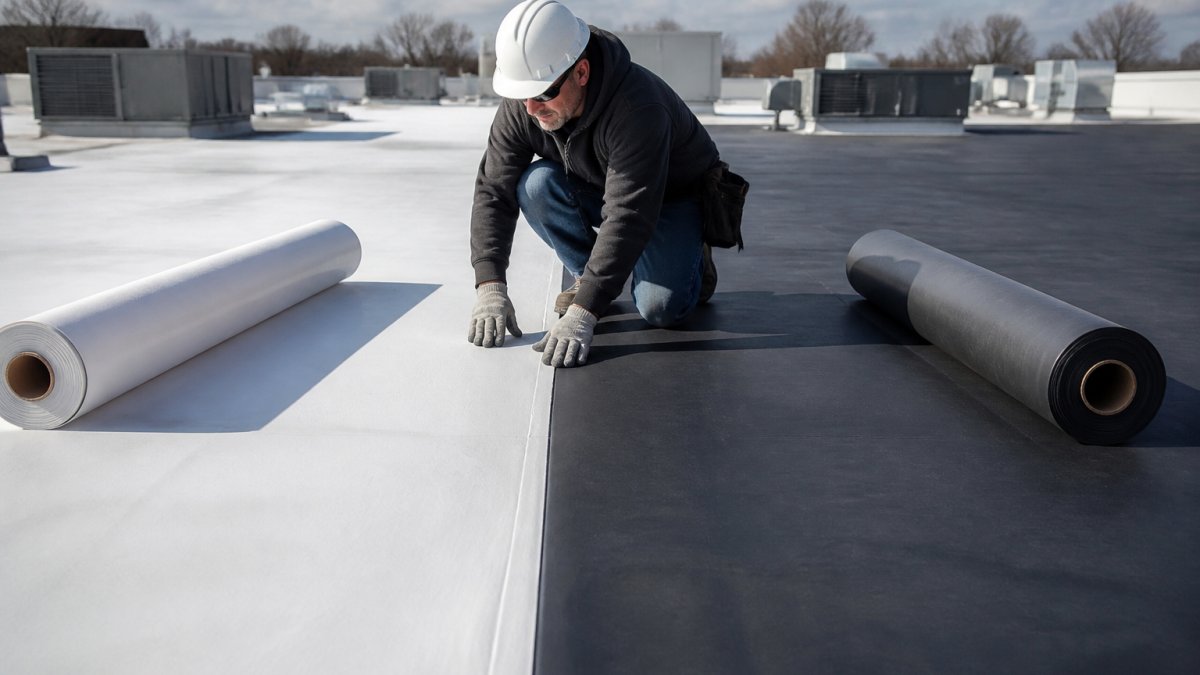
 comparison
TPO vs EPDM Roofing for Commercial Buildings
Table of Contents
- TPO and EPDM: Core Material Differences
- TPO Roofing Pros and Cons
- EPDM Roofing Pros and Cons
- Installation Methods and Seam Construction
- TPO vs EPDM Cost: Initial and Long-Term Investment
- Commercial Roof Membrane Lifespan and Durability
- Climate Performance and Energy Efficiency
- Maintenance, Repair, and Warranty Considerations
- Frequently Asked Questions
Last Updated: October 6, 2026
TPO and EPDM: Core Material Differences
When comparing TPO vs EPDM roofing for commercial buildings, you're looking at two single-ply membrane systems that dominate the flat roof market. Both thermoplastic polyolefin (TPO) and ethylene propylene diene monomer (EPDM) offer waterproofing, but differ in composition, installation, and performance.
TPO is a thermoplastic polymer that becomes flexible when heated, defining how it's installed and repaired. EPDM is a synthetic rubber that maintains elasticity through chemical composition rather than temperature sensitivity. This distinction helps property managers align decisions with their building's needs and climate.
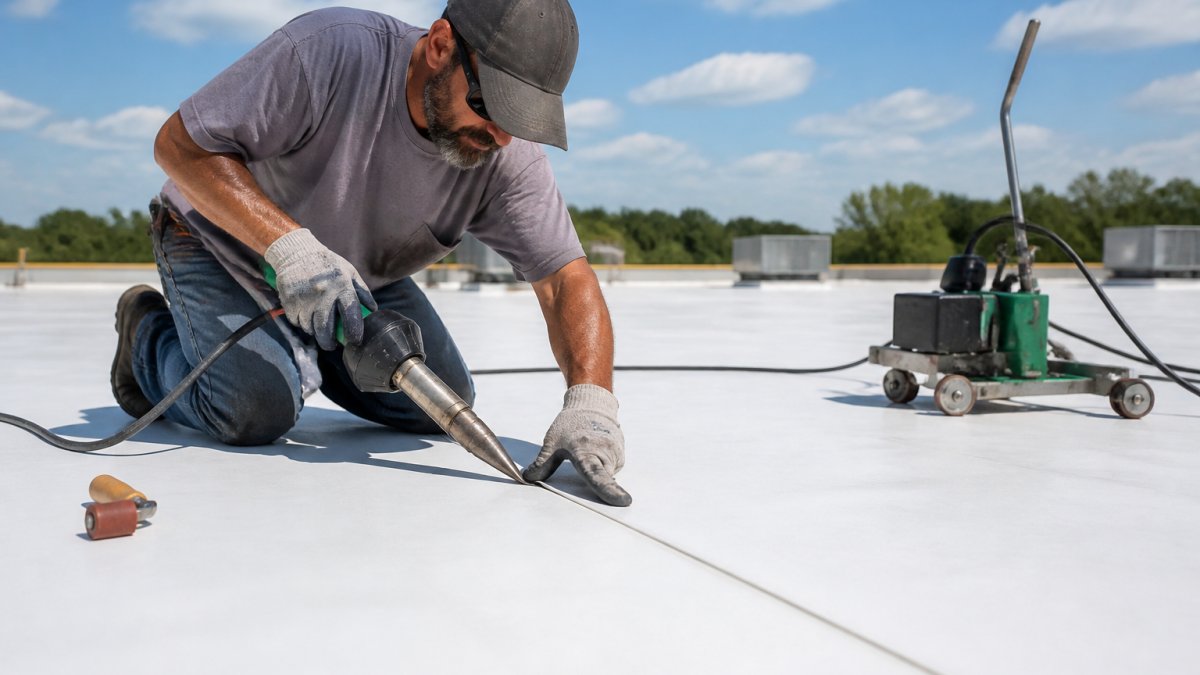
Seam construction reveals the most practical difference. TPO seams are heat-welded into a monolithic bond; EPDM seams rely on tape or liquid adhesives. This affects long-term durability, repair procedures, and maintenance protocols.
TPO Roofing Pros and Cons
TPO roofing delivers strong reflectivity and energy efficiency: the white surface reflects solar heat, reducing cooling costs in warm climates.
Advantages of TPO:
- Heat-welded seams create durable, monolithic bonds that resist water infiltration
- High solar reflectance reduces roof surface temperatures and cooling demand
- Material is recyclable, appealing to environmentally conscious property managers
- Seams are straightforward to repair using heat-welding equipment
- Generally lighter weight than some competing systems
Disadvantages of TPO:
- Seam quality depends heavily on installer expertise and equipment calibration
- UV exposure can cause membrane brittleness over time, particularly in harsh sun conditions
- Material costs and installation expenses vary significantly by region and contractor
- Puncture resistance, while decent, trails behind some EPDM formulations
- Long-term performance data is newer compared to EPDM, which has decades of field history
The real challenge with TPO emerges years after installation: if the original installer used substandard technique, reheating compromised seams can fail, and finding a contractor familiar with the membrane becomes critical.
EPDM Roofing Pros and Cons
EPDM rubber roofing has been the commercial standard for decades. Its track record spans multiple climate zones and building types, making it a proven choice for property managers seeking predictability and longevity.
Advantages of EPDM:
- Exceptional puncture and tear resistance due to rubber composition
- Superior cold-weather performance; rubber remains flexible even in freezing conditions
- Seam tape and adhesive repairs are straightforward and don't require specialized heat equipment
- Decades of field data demonstrate consistent 20-30 year service life under normal conditions
- Dark membrane provides excellent waterproofing and UV resistance inherently
Disadvantages of EPDM:
- Dark color absorbs solar heat, increasing cooling costs in warm climates
- Seams sealed with tape or adhesive may require periodic maintenance as adhesives age
- Membrane thickness varies; thinner versions (0.45 mil) offer less durability than 0.60 mil or 0.90 mil options
- Material is not recyclable in most markets, creating disposal considerations
- Seam strength depends on adhesive quality and application technique, which varies by contractor
EPDM's rubber composition is forgiving during installation; a technician with moderate experience can install and repair it competently, making it the default choice for property managers who prioritize reliability.
Installation Methods and Seam Construction
Installation separates TPO and EPDM in meaningful ways. TPO requires heat-welding equipment and trained operators; edges must reach precise temperatures to fuse properly, and improper heat application creates weak seams that fail prematurely.
EPDM installation offers more flexibility: seams are sealed with adhesive tape (most common) or hand-applied liquid adhesive. More contractors can do EPDM work competently, but quality varies with surface preparation and adhesive application.
Mechanically attached systems exist for both materials, using fasteners and plates to secure the membrane to the deck, eliminating seam adhesives or heat-welding but introducing penetrations that must be sealed. Fully adhered systems offer superior wind resistance but require more labor and specialized adhesives.
Seam construction determines repair difficulty and cost years later. TPO seams can be re-welded if equipment is available, but require a contractor with the right tools. EPDM seams can be patched with tape or liquid adhesive almost anywhere, making emergency repairs more accessible.
TPO vs EPDM Cost: Initial and Long-Term Investment
Most comparisons stop at the installed square-foot price, the least useful number for a commercial owner, since the membrane is one line item in a 20-to-30-year equation.
Installed cost structure. Both systems are priced per square (100 square feet) and include membrane, insulation, cover board, fasteners or adhesive, edge metal, flashing, and labor. TPO material prices lower per square, but heat-welding requires trained crews and calibrated equipment, pushing labor up.
Energy cost. TPO's white surface starts with high solar reflectance and thermal emittance, lowering peak roof surface temperature and cooling load in cooling-dominated buildings. EPDM's dark surface absorbs most solar radiation and runs hotter, raising cooling load but slightly reducing heating load in cold months.
Maintenance and repair cost. EPDM tape or adhesive seams are inexpensive to touch up but need periodic attention as adhesives age. Properly heat-welded TPO seams need less routine maintenance, but a failed TPO seam requires welding equipment and a trained technician, raising per-incident cost. Budget annual inspections for either system, plus more after hail, high wind, or heavy foot traffic.
Replacement and disposal cost. EPDM is generally not recycled, so end-of-life disposal is a landfill cost. TPO is recyclable in some markets, but access varies widely. Factor in tear-off, deck repair, and disposal when comparing a full replacement cycle.
Warranty terms and exclusions. Warranty language surprises many commercial owners. EPDM manufacturers commonly offer total-system warranties in the 15-to-30-year range depending on membrane thickness and components. TPO warranties vary more widely, some shorter, others into the 20-year range when the full assembly is specified. What matters more than the headline number:
- Workmanship coverage. Many manufacturer warranties cover material defects only. Labor to remove and replace a failed section may be excluded or capped.
- Seam requirements. TPO warranties typically require heat-welded seams meeting a minimum peel strength; EPDM warranties typically require approved tape or adhesive systems. Deviating from the specified method can void coverage.
- Maintenance obligations. Most warranties require documented inspections and prompt repair of damage. Skipping them is a common reason claims are denied.
- Common exclusions. Ponding water, chemical exposure, foot traffic damage, hail, and damage from other trades are frequently excluded.
- Transferability. If you may sell the building, confirm whether the warranty transfers and what fee or inspection is required.
ENERGY STAR reflective roof criteria and Cool Roof Rating Council product ratings
Commercial Roof Membrane Lifespan and Durability
Durability expectations for TPO vs EPDM roofing differ by material properties and environmental exposure. EPDM typically delivers 20-30 years under normal conditions, with some installations exceeding 35 years, thanks to rubber's resistance to UV degradation and flexibility in temperature extremes.
TPO service life depends more heavily on installation quality and climate. In moderate climates with proper installation, TPO roofs commonly reach 20-25 years; in harsh UV environments or with suboptimal seam workmanship, life may be shorter.
Puncture and tear resistance directly impact durability. EPDM's rubber composition resists mechanical damage, foot traffic, debris impact, and equipment placement better. TPO is more susceptible to puncture from sharp objects or concentrated loads, which matters on roofs with frequent maintenance access or rooftop equipment.
Weather resistance varies by climate zone. EPDM excels in cold climates where rubber stays flexible and seams don't become brittle; TPO performs well in moderate to warm climates where reflectivity adds benefit. In extreme temperature swings, fatigue affects both systems, though EPDM's rubber handles thermal cycling more gracefully.
Climate Performance and Energy Efficiency
The reflectivity difference between TPO and EPDM is real, but its value depends on where the building sits, how it's used, and how it's insulated. A generic "TPO saves energy, EPDM costs energy" claim is not a decision. Here's how to translate the physics into a recommendation.
The mechanism. Solar reflectance (how much sunlight bounces off) and thermal emittance (how quickly the surface re-radiates absorbed heat) determine how hot a roof runs. TPO's white surface starts with high reflectance and emittance, staying cooler.
Cooling-dominated climates. In hot, sunny regions with long cooling seasons and high utility rates, TPO's cooler surface reduces peak cooling load and can lower demand charges. The benefit is largest on buildings with low-to-moderate insulation, large roof-to-floor ratios, and heavy daytime cooling.
Heating-dominated climates. In cold regions, EPDM's darker surface absorbs solar heat and can slightly reduce heating load in shoulder seasons. More importantly, EPDM stays flexible at low temperatures, making it easier to install and repair in cold weather and reducing cold-cracking at seams.
Mixed and extreme climates. With hot summers and cold winters, the annual energy difference narrows because EPDM's cooling penalty and TPO's heating penalty partially offset. Prioritize insulation R-value and assembly design first, a well-insulated roof reduces the membrane's energy influence regardless of color.
Reflectivity degrades. TPO's initial reflectance drops as dust, algae, and weathering accumulate, often within the first several years. Regular cleaning helps preserve the energy benefit, but the roof won't stay at its rated reflectance forever.
Building-use considerations.
- Warehouses and distribution centers with large, lightly insulated roofs and heavy cooling loads often favor TPO.
- Cold-storage and food-processing buildings may prioritize EPDM's cold-weather flexibility and puncture resistance.
- Office and retail buildings in mixed climates should weigh insulation upgrades and HVAC efficiency before choosing a membrane color.
- Buildings with heavy rooftop traffic (HVAC service, equipment replacement) benefit from EPDM's puncture and tear resistance.
- Buildings pursuing green certification may favor TPO for its recyclability and reflective properties, but should verify local recycling access.
DOE Building America climate zone map and guidance
Maintenance, Repair, and Warranty Considerations
Maintenance requirements differ between TPO and EPDM roofing systems. EPDM roofs benefit from periodic inspection and cleaning to prevent algae growth and debris accumulation. Inspect tape-sealed seams every 2-3 years, especially after extreme weather; if tape edges lift or adhesive breaks down, resealing is straightforward and inexpensive.
TPO maintenance focuses on seam integrity and membrane condition. Heat-welded seams are generally more stable, but visible gaps, splits, or separation warrant professional inspection. Regular cleaning maintains reflectivity and prevents UV degradation; avoid harsh chemicals or pressure washing, which damage the membrane surface.
Repair procedures reveal practical differences. A small TPO puncture or tear needs heat-welded patches, requiring specialized equipment and trained technicians. EPDM punctures are patched with adhesive-backed patches or liquid adhesive, which most roofing contractors can perform, making EPDM faster and more accessible for emergency repairs.
Warranty terms vary significantly by manufacturer and product line. EPDM warranties typically cover 20-25 years against material defects, with some extending to 30. TPO warranties range from 10-20 years depending on membrane thickness and formulation.
The most relevant warranty exclusion is installation quality. Both TPO and EPDM warranties require proper installation by certified contractors; workmanship issues, improper seam construction, inadequate surface preparation, or incorrect fastening void coverage. Choose an experienced contractor who understands the material's specific requirements.
Choosing between TPO vs EPDM roofing for commercial buildings means weighing energy efficiency, durability, climate fit, and long-term maintenance costs. Both systems deliver reliable waterproofing when properly installed and maintained.
Frequently Asked Questions
How do TPO and EPDM compare in cost for commercial buildings?
TPO typically costs less upfront than EPDM per square foot, but total cost depends on roof size, installation complexity, and local labor rates. EPDM may have lower lifetime costs if repair needs are minimal. Pricing varies by region and contractor. Contact Certified Roofing Solutions Inc. for a detailed quote tailored to your building's specifications and current market conditions.
How long do TPO and EPDM commercial roofs last?
Both TPO and EPDM single-ply membranes typically deliver 15-20 years of service life with proper maintenance. TPO may extend toward the upper range in cooler climates, while EPDM performs well across diverse weather conditions. Actual lifespan depends on installation quality, maintenance frequency, roof traffic, and UV exposure. Regular inspections and prompt repairs extend the life of either system.
Which roofing membrane is easier to repair, TPO or EPDM?
Both TPO and EPDM can be patched quickly. Experienced contractors can assess damage and recommend the best repair approach for your situation.
Is TPO or EPDM better for a commercial roof with heavy foot traffic?
Protective walkways can extend the life of either membrane.